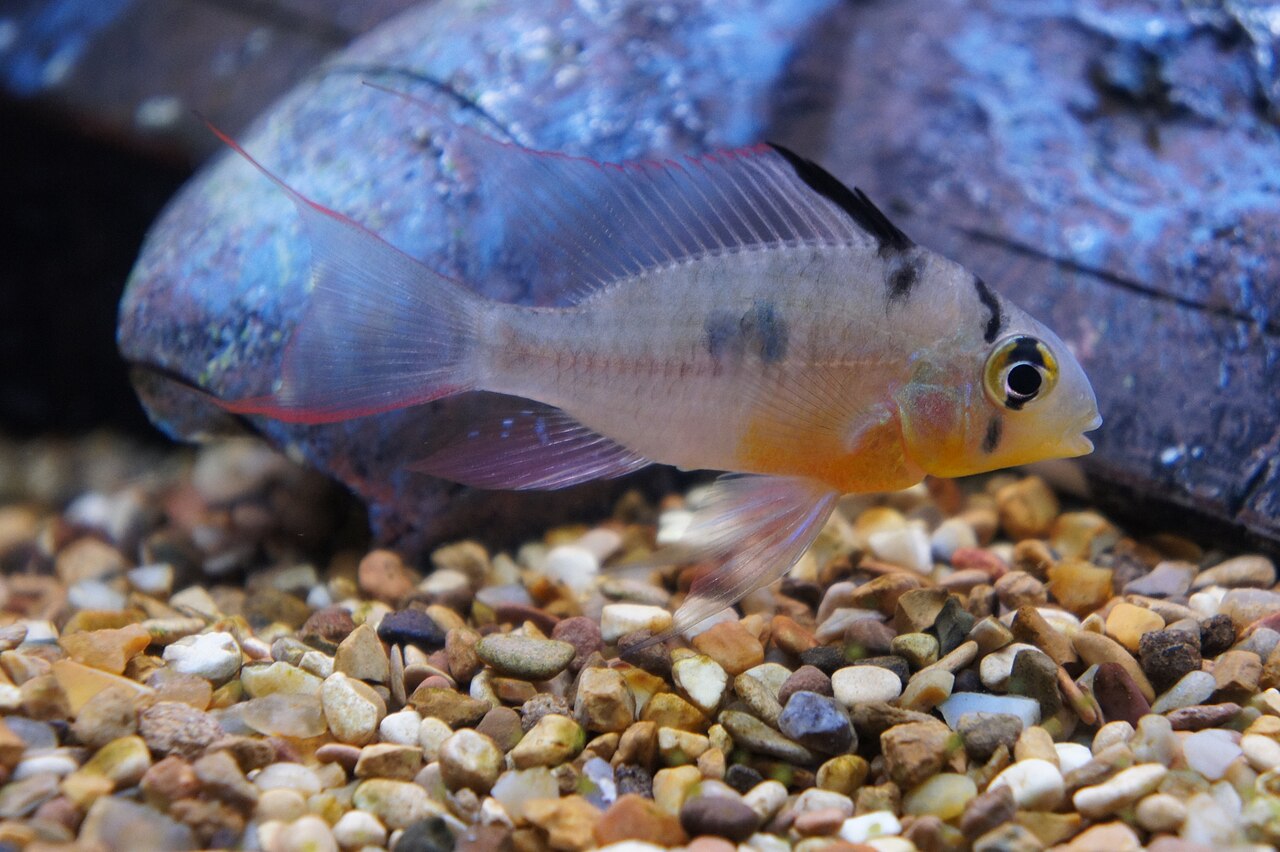
Bolivian rams (Mikrogeophagus altispinosus) are peaceful dwarf cichlids from South America. They stay small, reach about 3 inches, and show subtle color that deepens when they settle in. Many keepers pass them by in store tanks because they look washed out under bright lights. Once home in a planted aquarium, they display pink bellies, blue spangling, and red fin edges. Compared with German blue rams, this species is more forgiving and easier for beginners. If you want a close relative, check the ram cichlid care guide for more options.
Tank size matters more than many people assume. A 20-gallon long tank is the minimum for a pair. These fish spend most of their time on the bottom, so floor space matters more than height. A 30-gallon tank is better if you want tank mates. Add fine sand, plants, and driftwood to break sight lines. Overstocking leads to stress and territorial fights. You can use our best beginner fish tanks guide to compare setups.
Bolivian rams are omnivores and accept most prepared foods. They are not picky, but they need variety to stay healthy and colorful. Their peaceful nature allows them to share a tank with small schooling fish. They do become protective during spawning, so you need a layout with hiding spots. Good tank mates include small tetras and corydoras. We cover compatible species in a later step, including neon tetra care guide.
This care guide follows established fishkeeping advice from sources like Aqueon and Aquarium Co-Op. We provide specific parameters and product suggestions for every step. Follow the steps below and you will keep a healthy, long-lived Bolivian ram. With good care, these fish can live four to six years. They are rewarding for beginners and experienced keepers alike. Let’s start with the tank setup and water conditions.
What You’ll Need
- 20-gallon long aquarium
- Aquarium heater
- Power filter
- Fine sand substrate
- Live plants and driftwood
- API Freshwater Master Test Kit
- Sinking cichlid pellets
How Do You Care for Bolivian Rams?
- Set Up a Spacious Tank with the Right Footprint
A 20-gallon long tank is the minimum for a single pair of Bolivian rams. These fish are not open-water swimmers. They use the bottom third of the aquarium. A long tank with more floor space gives each fish room to claim a small territory. If you plan to keep a small group or add tank mates, choose a 30-gallon or 40-gallon breeder tank. More volume dilutes waste and keeps water stable. If you are new to this, our best beginner fish tanks article can help you pick a setup.
The substrate should be fine sand or smooth, small gravel. Bolivian rams sift mouthfuls of sand and expel it from their gills. This is natural feeding behavior. Sharp or coarse gravel can injure their gill covers and mouths. Use pool filter sand or aquarium sand. Add a thin layer, around 1 to 2 inches. It supports live plants and beneficial bacteria without trapping too much waste. A sand bed also looks natural and encourages the fish to behave normally.
Filtration should be gentle but effective. Bolivian rams do not like strong current. A hang-on-back filter or sponge filter works well. If you use a powerful canister filter, point the output toward the surface or use a spray bar. Add a heater rated for your tank size. A reliable heater is important for stable temperatures. Check the Eheim Jager Aquarium Heater on Amazon. This heater holds consistent temperatures in most tanks.

- Maintain Warm, Soft, Stable Water Parameters
Bolivian rams prefer water between 73 and 79 degrees Fahrenheit. The pH should stay between 6.0 and 7.5. They tolerate moderately hard water better than German blue rams. Still, soft to moderate hardness is best. Stability matters more than chasing perfect numbers. Rapid pH swings or temperature drops cause stress and disease. Use a liquid test kit every week. I recommend the API Freshwater Master Test Kit for reliable readings.
Cycle the tank fully before adding rams. They are sensitive to ammonia and nitrite. A fishless cycle takes four to six weeks. If you need a refresher, read our how to cycle a fish tank guide. Never add rams to a brand new tank. Even small ammonia spikes burn their gills. Once cycled, change about 25 percent of the water every week. Use a gravel vacuum to remove waste from the sand surface.
If your tap water pH is high, you may need to lower it gradually. Do not use harsh pH chemicals. Natural methods include driftwood, Indian almond leaves, and peat. Our how to lower ph in aquarium guide covers safe approaches. Aqueon reminds keepers that stable, matched source water usually beats chemical adjustments. Test tap water before you decide to adjust anything.
- Provide a Natural Habitat with Hiding Spots
Bolivian rams need structure. Use driftwood, rocks, and live plants to break sight lines. This reduces stress and gives submissive fish a place to retreat. Broadleaf plants like Amazon swords and crypts create shaded areas. Floating plants like frogbit can dim the light. Rams feel safer under cover. They are more active and colorful when they know they can hide.
Add caves and flat stones. Bolivian rams often spawn on flat rock surfaces. They also rest under overhangs. Arrange rocks securely so they cannot topple. Driftwood provides tannins that soften water and lower pH slightly. Best aquarium plants for beginners has options that thrive in low to medium light. Java fern and anubias attach to wood and need little care.
Leave open sand areas in the foreground. This is where the rams will sift and feed. Avoid covering every inch with plants or decor. A mix of open space and cover matches their natural habitat. Add a background or paint the back of the tank. This makes fish feel less exposed. It also improves how their colors appear to you.

- Feed a Varied Omnivore Diet
Bolivian rams are not picky. They accept high-quality sinking pellets, micro pellets, and flakes. Use a cichlid pellet as a staple. Sinking foods work best because rams feed near the bottom. Feed small meals twice a day. Only offer what they can eat in two to three minutes. Uneaten food rots and spikes ammonia. Remove any leftover food after feeding.
Add frozen and live foods to the rotation. Bloodworms, brine shrimp, daphnia, and blackworms are all good. These proteins bring out spawning behavior and deep color. Feed frozen foods two or three times per week. You can offer live baby brine shrimp as a treat. Avoid tubifex worms from questionable sources. They can carry parasites. A varied diet also keeps the fish interested and active.
Include some vegetable matter. Blanched zucchini, spinach, and shelled peas are easy options. You can also use spirulina flakes or algae wafers. A varied diet prevents bloat and supports digestion. Poor diet is a major cause of disease in dwarf cichlids. A good staple is NorthFin Cichlid Pellets. Feed that as the base and rotate the other foods around it.
- Choose Peaceful Tank Mates Carefully
Bolivian rams are peaceful for cichlids. They do well with small, non-aggressive fish. Good tank mates include tetras, rasboras, corydoras catfish, and small plecos. Avoid fin-nippers like tiger barbs and large or aggressive cichlids. They will stress or injure the rams. You can keep them with neon tetras and harlequin rasboras in a community tank. Both are small and fast enough to avoid a breeding pair.
Bottom dwellers can coexist if there is enough floor space. Corydoras and rams both use the bottom but occupy different microhabitats. A 30-gallon or larger tank works best. Avoid keeping Bolivian rams with other dwarf cichlids in a small tank. They may spar over territories. If you want another dwarf cichlid, choose a larger tank with many broken sight lines. Read our apistogramma care guide if you want a different dwarf cichlid option.
Watch for spawning aggression. Once a pair lays eggs, they defend a small area. In a spacious tank, this is manageable. In a crowded 20-gallon, it can become a problem. Give other fish room to avoid the nest. A pair of rams can live with a school of cardinal tetras and a group of panda corydoras comfortably. Keep the water volume above 30 gallons for that mix.
- Observe Social Behavior and Consider a Pair or Group
Bolivian rams can be kept singly, in a pair, or in a small group. A single ram works in a peaceful community tank. A bonded pair is more interesting. If you want a pair, buy a group of six juveniles and let them pair naturally. Forced pairs from the store may not bond. Two males in a small tank will fight. A group also allows you to observe natural behaviors.
These fish communicate through body posture and color. A dominant ram displays brighter colors and holds its fins high. Submissive fish pale and retreat. This is normal. If you see constant chasing with torn fins, separate the aggressor or rearrange the tank. Adding more hiding spots often reduces tension. Rams do not school, but they interact with their own kind.
If you keep a small group, provide at least 10 gallons per adult after the first 20 gallons. A 40-gallon breeder can house four to six rams. This setup allows natural pair formation. It also reduces aggression because no single fish controls every corner. A spacious group tank is one of the best ways to see natural behavior. Just keep water changes consistent because a larger group creates more waste.
- Perform Weekly Maintenance and Monitor Health
Weekly water changes are not optional. Change about 25 percent of the water every week. Use a gravel vac to lift debris from the sand without sucking up too much sand. Match the new water temperature to the tank. Add a dechlorinator to remove chlorine and chloramine. This keeps nitrate low and minerals balanced. Read how often to change aquarium water for more detail.
Test water before each water change. Record ammonia, nitrite, nitrate, pH, and temperature. Ammonia and nitrite should always be zero. Nitrate should stay below 20 ppm. If nitrate climbs, increase water change frequency or reduce feeding. Bolivian rams are hardy but not invincible. Poor water quality leads to ich, fin rot, and bacterial infections. How to treat ich in aquarium explains how to handle the most common parasite.
When adding new fish, quarantine them for at least two weeks. Use a separate 10-gallon tank. Observe for white spots, clamped fins, or rapid breathing. Treat issues in quarantine before introducing fish to the display. This saves your main tank from disease. Aquarium Co-Op has useful videos on quarantine and fish health. If a ram looks off, test the water first. Many health problems start with water quality.

- Condition and Breed Bolivian Rams
Breeding Bolivian rams is possible for most keepers. Start with a bonded pair in a clean, cycled tank. Raise the temperature slightly to 77 to 79 degrees Fahrenheit. Feed high-quality live and frozen foods. Bloodworms and baby brine shrimp condition the female. Provide flat stones or slate. Rams often clean a flat surface before spawning.
The female lays 100 to 200 eggs. Both parents guard the eggs. Eggs hatch in about 60 hours. Fry become free-swimming after five to seven days. The parents may move the fry to pits in the sand. Leave the parents with the fry if they are caring for them. If they eat the eggs, remove the eggs to a separate hatching tank or let them try again. Young pairs often fail the first few spawns.
Feed fry infusoria or commercial liquid fry food for the first week. Then offer baby brine shrimp and powdered fry food. Keep water very clean with small daily water changes. A cycled sponge filter prevents fry from being sucked up. As they grow, separate large juveniles to avoid stunting. This step is optional but rewarding. It also connects to understanding the aquarium nitrogen cycle, because fry are sensitive to waste.
Red Flags & Warnings
- 🚨 Do not keep Bolivian rams with large or aggressive cichlids. They are peaceful and will be stressed or injured.
- 🚨 Avoid sharp gravel or coarse substrate. Bolivian rams sift sand and can damage their gills or mouth.
- 🚨 Never skip water changes. Nitrate buildup weakens their immune system and invites ich.
- 🚨 Do not feed only flake food. A varied diet prevents bloat and color loss.
- 🚨 Avoid sudden temperature swings. Use a reliable heater and acclimate new rams slowly.
- 🚨 Quarantine new fish for at least two weeks. This prevents introducing disease to your main tank.
Frequently Asked Questions
How big do Bolivian rams get?
Bolivian rams reach about 3 inches in length. Males are slightly larger than females. They grow slowly and need a stable environment to reach full size.
What is the minimum tank size for Bolivian rams?
A 20-gallon long tank is the minimum for a pair. More floor space is better. For a small group or community tank, use 30 gallons or larger.
Are Bolivian rams aggressive?
They are peaceful for cichlids. They may chase other fish near their nest during spawning. In a spacious tank with hiding spots, aggression stays low.
What do Bolivian rams eat?
They eat sinking pellets, flakes, frozen bloodworms, brine shrimp, and blanched vegetables. A varied diet keeps them healthy and colorful. Feed small amounts twice a day.
Can Bolivian rams live with neon tetras?
Yes. Neon tetras are small, peaceful, and fast. Keep them in a tank with enough space and cover. A breeding pair of rams may chase them near the nest, but injuries are rare.
How can you tell male and female Bolivian rams apart?
Males are larger and develop longer dorsal and anal fin extensions. Females have rounder bodies and often show a pinker belly when ready to breed.
What Should You Remember?
- Tank size: Keep a single pair in at least a 20-gallon long tank.
- Water parameters: Maintain 73 to 79 degrees Fahrenheit and pH between 6.0 and 7.5.
- Diet: Feed sinking pellets, frozen bloodworms, and blanched vegetables.
- Tank mates: Choose peaceful tetras, corydoras, and rasboras.
- Substrate: Use fine sand to protect their sifting behavior.
- Maintenance: Change 25 percent of the water weekly and test parameters.
- Breeding: Offer flat rocks and soft water to encourage spawning.
This article is for general information only and is not a substitute for professional veterinary or aquarium specialist advice. Always research the specific needs of your fish and consult an expert before making care decisions.