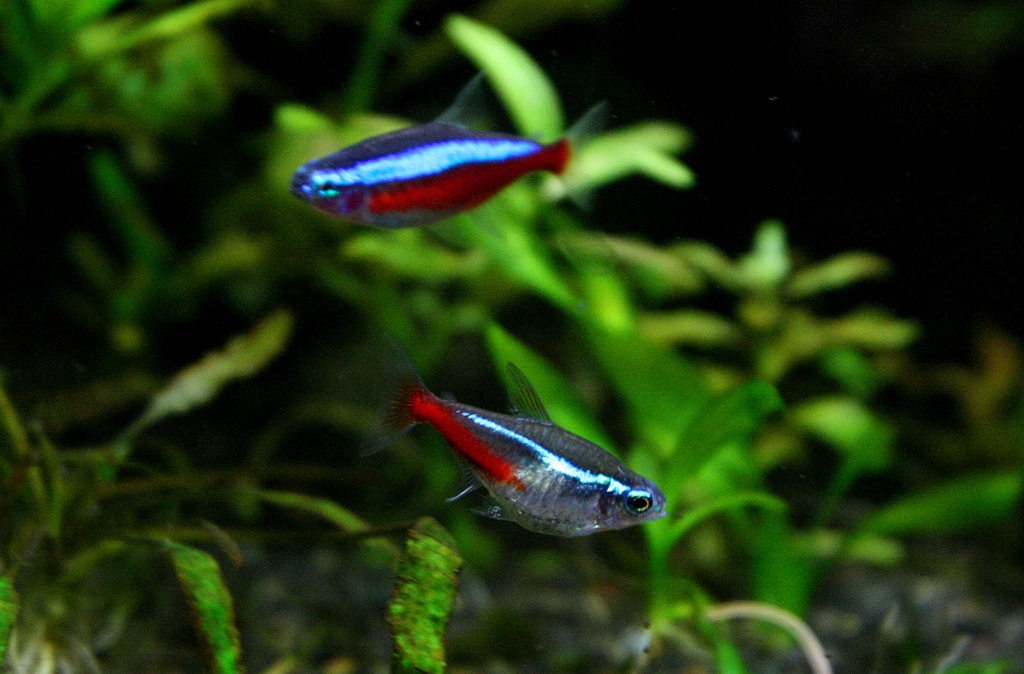
Neon tetras are among the most popular freshwater fish for home aquariums. Their electric blue stripe and red tail make them instantly recognizable. Many beginners choose them because they are small, peaceful, and relatively easy to care for. If you are new to fishkeeping, neon tetras often appear on lists of the best fish for beginners. That said, they do have specific needs. They are not disposable fish. They require a stable, cycled tank and proper water chemistry to thrive.
Neon tetras originate from the blackwater streams of South America. According to Aqueon, these fish live in soft, acidic water with plenty of leaf litter and dim lighting. In the wild, they school in large numbers to avoid predators. Replicating those conditions in the home aquarium is the key to long-term health. Hard water with high pH can stress neon tetras over time, even if they survive for a while. That is why water chemistry matters more than many new keepers realize.
Another common mistake is keeping too few neon tetras. They are schooling fish, not solitary fish. A group of three or four will often hide, become stressed, and may even stop eating. Stress weakens their immune system and opens the door to disease. A proper school reduces aggression and makes the fish more active and colorful. When you see a large group of neon tetras moving together, you understand why they are so beloved.
This guide walks you through every part of neon tetra care. You will learn the right tank size, how to cycle the aquarium, the best diet, and which tank mates work well. We will also cover common warnings and answer frequently asked questions. By the end, you should feel confident setting up a healthy home for a school of neon tetras. Remember that patience beats speed. Rushing the setup or adding fish too soon causes most beginner failures. Take your time, follow each step, and your neon tetras will reward you with years of color and activity.
What You’ll Need
- 10-gallon or larger aquarium
- Aquarium heater with thermostat
- Aquarium filter rated for your tank size
- Thermometer
- Water test kit (ammonia, nitrite, nitrate, pH)
- Water conditioner/dechlorinator
- Gravel vacuum
- High-quality flake or micro pellet food
- Frozen or live fish food (optional)
- Live plants or decorations for hiding spots
How Do You Care for Neon Tetras?
- Start with a 10-gallon tank or larger
The minimum tank size for a school of six neon tetras is 10 gallons. That rule comes from their adult size of up to 1.5 inches and their need to swim. A 10-gallon tank measures 20 inches long, 10 inches wide, and 12 inches high. That footprint gives a small school enough horizontal space to move. Smaller tanks, like 5 gallons, are too cramped. The fish may survive, but they will not thrive.
Many experienced keepers recommend a 20-gallon long tank for neon tetras. A 20-gallon long has a larger footprint, which allows for better swimming and more stable water chemistry. Larger water volumes dilute waste and temperature swings. If you plan to add tank mates, a 20-gallon long or larger is the better choice. You can find budget-friendly starter kits that include a tank, filter, and light. Check out best beginner fish tanks for options that suit a small school.
Tank size also affects your maintenance routine. A 10-gallon tank needs weekly water changes of about 25 percent. A 20-gallon tank is more forgiving if you miss a change by a day or two. Still, do not overstock even in a larger tank. Neon tetras are small but produce waste like any fish. Keep the bioload low to avoid ammonia and nitrite spikes.
Before you buy a tank, measure the space where it will sit. A filled 10-gallon tank weighs about 100 pounds. Use a sturdy stand or aquarium-specific furniture. Place the tank away from direct sunlight to reduce algae growth. Once the tank is set, you cannot easily move it. Plan the location first, then move on to cycling.

- Cycle the aquarium completely first
Neon tetras are sensitive to ammonia and nitrite. A new tank does not have the beneficial bacteria needed to convert fish waste. If you add fish immediately, they can die from ammonia poisoning. That condition is called new tank syndrome. The solution is to cycle the tank before you buy any fish. Cycling takes four to six weeks on average.
The nitrogen cycle starts when you add a source of ammonia. Beneficial bacteria then convert ammonia into nitrite, and another bacteria converts nitrite into nitrate. Nitrate is less toxic and removed through water changes. You can learn the full process in this guide on the aquarium nitrogen cycle. For a step-by-step method, see how to cycle a fish tank.
Use a liquid test kit to monitor ammonia, nitrite, and nitrate. The API Freshwater Master Test Kit is a reliable choice. Check the API Freshwater Master Test Kit on Amazon. Test daily during cycling. You know the cycle is complete when ammonia and nitrite read zero and nitrate appears. Only then should you add neon tetras.
Some people try to speed up cycling with bottled bacteria. Those products can help but are not always reliable. The safest approach is to be patient. Neon tetras are not hardy enough for fish-in cycling. Stick to fishless cycling with pure ammonia or fish food. Your neon tetras will thank you.
- Keep water parameters stable and within range
Neon tetras prefer a water temperature between 70°F and 81°F, or 21°C to 27°C. Use a reliable heater with a built-in thermostat to prevent temperature swings. A sudden drop of a few degrees can stress the fish. Place a thermometer at the opposite end of the tank from the heater. Check the temperature daily.
The pH should stay between 6.0 and 7.0. Soft to moderately hard water is best, with a general hardness of 1 to 10 dGH. If your tap water is very hard or has a high pH, consider mixing with reverse osmosis water. Do not use chemical pH adjusters. They cause rapid changes that harm fish more than a stable but slightly off value. Aquarium Co-Op has a good reference for understanding water parameters.
Stability matters more than hitting a perfect number. Neon tetras can adapt to pH 7.2 if it stays constant. Wild swings from 6.5 to 7.5 overnight are far worse. Test your water weekly after the tank is established. Keep a log so you notice trends before problems appear. If you need to adjust pH, do it slowly over several days.
For heaters, look for an adjustable model sized for your tank. A 50-watt heater works for a 10-gallon tank. Check the best aquarium heaters for recommendations. Also use a water conditioner to remove chlorine and chloramine before adding tap water.

- Feed small, varied meals two to three times daily
Neon tetras are omnivores with small mouths. They do best on a mix of high-quality flakes, micro pellets, and frozen or live foods. Flakes can be crushed between your fingers to make them small enough. Micro pellets sink slowly and are easier for mid-water feeders to catch. Avoid large pellets that the fish cannot swallow.
A good base food is Fluval Bug Bites Tropical Formula. It contains insect larvae and is small enough for neon tetras. Check the Fluval Bug Bites Tropical Formula on Amazon. Supplement with frozen or live foods like daphnia, brine shrimp, and bloodworms. Feed frozen foods no more than two to three times per week. Live foods are great for conditioning but can introduce disease if not from a clean source.
Feed only what the fish can eat in two minutes, two to three times per day. Overfeeding is a common beginner mistake. Uneaten food decays and produces ammonia. That forces you to do more water changes. If you see food on the substrate after five minutes, you fed too much. Remove the excess with a gravel vacuum or turkey baster. For more on water quality, read how often to change aquarium water.
Neon tetras also benefit from plant matter in their diet. You can offer blanched zucchini or spinach once a week. Remove any uneaten vegetables after 24 hours. A varied diet keeps their colors bright and their immune systems strong.
- Select peaceful, similarly sized tank mates
Neon tetras are peaceful community fish. They should never be kept with aggressive or large species that might eat them. Avoid tiger barbs, cichlids, and most catfish that grow large. Even peaceful fish like angelfish may see neon tetras as food once they mature. Check the angelfish care guide to understand why they are risky. A better choice is to stick with small, non-aggressive species.
Good tank mates include corydoras catfish, small rasboras like harlequin rasboras, and dwarf shrimp. Corydoras stay near the bottom and do not compete with neon tetras for food. Harlequin rasboras occupy the mid-water but are peaceful and similar in size. You can also consider small tetras like ember tetras or black phantom tetras. Read the black phantom tetra care guide for another schooling option.
Do not keep neon tetras with bettas unless the tank is large and heavily planted. Bettas can be territorial and may attack the tetras. The tetras may also nip at a betta’s long fins. If you want to try, use a 20-gallon long with plenty of hiding spots. For more on betta temperament, see the betta fish care guide.
Always research a species before adding it. Look at adult size, temperament, and water parameter needs. A fish that is peaceful as a juvenile may become a predator later. Also avoid fish that require very different water conditions, like high pH or hard water. Matching water chemistry is as important as matching temperament.
- Never keep fewer than six neon tetras
Neon tetras are schooling fish. In the wild, they live in groups of hundreds. In the aquarium, a group of at least six is the absolute minimum. Many keepers recommend 10 to 12 for the best behavior. Smaller groups become stressed and hide constantly. Stressed fish are more likely to get sick.
A larger school also spreads out aggression. Neon tetras are not aggressive, but males may chase each other during spawning. In a group of six, one fish can become the target. With 10 or more, any chasing is diluted across the group. The fish also feel safer and will swim in the open more often.
Schooling does not mean the fish swim in a tight ball all day. They often spread out but remain near each other. When startled, they will quickly group together. That behavior is natural. If your fish are scattered constantly and never school, they may be stressed or the tank may be too small. Compare with the rummy nose tetra care guide to see another fish that schools tightly.
Choose one species of schooling fish if you have a small tank. Mixing multiple schooling species can look chaotic. If you add another tetra species, make sure the tank is large enough for two schools. A 20-gallon long can handle one school of neon tetras and one school of another small tetra. A 10-gallon cannot.

- Change water weekly and clean the substrate
Neon tetras are sensitive to poor water quality. A regular maintenance schedule keeps ammonia and nitrite at zero and nitrate low. Change 25 to 30 percent of the water every week. Use a gravel vacuum to remove waste from the substrate. Do not replace all the water at once. That can shock the fish.
When you change water, treat the new water with a dechlorinator. Match the temperature of the new water to the tank water as closely as possible. A thermometer helps. Add the water slowly to avoid disturbing the fish. You can also use a Python water changer for easier water changes. Check the best aquarium filters to make sure your filter is adequate for the tank size.
Clean the filter media once a month, but do not replace it all at once. Rinse mechanical media in old tank water, not tap water. Tap water contains chlorine that kills beneficial bacteria. Replace chemical media like activated carbon as directed. The goal is to preserve the bacteria that cycle the tank.
Live plants can help maintain water quality by absorbing nitrate. Java fern, anubias, and floating plants are easy choices for beginners. They also provide hiding spots for neon tetras. Learn more about easy plants in the best aquarium plants for beginners. A well-planted tank needs less frequent water changes, but weekly is still a good habit.
- Quarantine all new fish before adding them to the main tank
Neon tetra disease is a common and often fatal condition. It is caused by a parasite that spreads quickly. Symptoms include loss of color, a curved spine, and difficulty swimming. There is no reliable cure. The best defense is to quarantine new fish for two to four weeks before adding them to your display tank.
Set up a small quarantine tank, such as a 5 or 10 gallon. Use a simple sponge filter and heater. Do not use substrate or plants that could harbor parasites. Observe the fish daily for signs of illness. If a fish shows symptoms, treat it in the quarantine tank. You can also use a medication like API General Cure, but always follow the label. For more on common diseases, see how to treat ich in aquariums.
When buying neon tetras, inspect the tank at the store. Avoid tanks with dead fish, cloudy water, or fish that look thin or have clamped fins. Ask the store when the fish arrived. Newly arrived fish are more stressed and may break out with disease later. It is often better to wait a week after the store receives a shipment before buying.
Also consider that neon tetras are often confused with cardinal tetras. Cardinal tetras have a longer red stripe, while neon tetras have a red stripe that stops halfway. Cardinal tetras are slightly more sensitive and need warmer water. If you want the differences explained, read cardinal tetra care guide. Knowing which fish you have helps you provide the right care.
Red Flags & Warnings
- 🚨 Never add neon tetras to an uncycled tank. Ammonia and nitrite will kill them quickly. Cycle the tank first and test the water before purchasing fish.
- 🚨 Avoid sudden temperature or pH changes. A rapid drop of more than 3°F can stress the fish and trigger illness. Always acclimate new fish slowly.
- 🚨 Do not keep neon tetras with large or aggressive fish. Angelfish, cichlids, and tiger barbs may attack or eat them. Choose peaceful community species only.
- 🚨 Watch for neon tetra disease. Symptoms include fading color, a bent spine, and isolation. Remove affected fish immediately to reduce spread.
- 🚨 Overfeeding causes ammonia spikes and cloudy water. Feed only what the fish consume in two minutes, two to three times daily. Remove uneaten food.
- 🚨 Do not buy fish from tanks with dead or sick fish. Quarantine all new fish for at least two weeks before adding them to your main aquarium.
Frequently Asked Questions
What is the minimum tank size for neon tetras?
A 10-gallon tank is the minimum for a school of six neon tetras. A 20-gallon long is better because it provides more swimming space and more stable water chemistry. Larger tanks also allow you to keep more fish.
What do neon tetras eat?
Neon tetras eat a varied diet of high-quality flakes, micro pellets, and frozen or live foods like brine shrimp, daphnia, and bloodworms. Feed small portions two to three times a day. Remove any uneaten food after two minutes.
Can neon tetras live with bettas?
Sometimes, but it is risky. Bettas can be territorial and may attack neon tetras, especially in small tanks. A 20-gallon long with heavy planting and hiding spots reduces the risk, but there is no guarantee of peaceful coexistence.
How many neon tetras should be kept together?
Keep at least six neon tetras together. A group of 10 to 12 is even better because it reduces stress and encourages natural schooling behavior. Smaller groups often hide and become more susceptible to disease.
What water temperature do neon tetras need?
Neon tetras thrive at temperatures between 70°F and 81°F (21°C to 27°C). Use a reliable heater and a thermometer to keep the temperature stable. Quick temperature swings are more harmful than being slightly outside the range.
How long do neon tetras live?
With proper care, neon tetras can live 5 to 10 years in a home aquarium. Good water quality, a varied diet, and a stress-free environment are the keys to a long lifespan.
What Should You Remember?
- Tank size: Provide at least a 10-gallon tank for a school of six neon tetras. A 20-gallon long is better.
- Water parameters: Keep temperature between 70°F and 81°F and pH between 6.0 and 7.0.
- Schooling: Never keep fewer than six neon tetras. A group of 10 or more is ideal.
- Diet: Offer a varied diet including quality flakes, micro pellets, and frozen or live foods.
- Tank mates: Choose small, peaceful species like corydoras catfish and harlequin rasboras.
- Maintenance: Change 25 percent of the water weekly and test water parameters regularly.
This article is for general information only and is not a substitute for professional veterinary or aquarium specialist advice. Always research the specific needs of your fish and consult an expert before making care decisions.