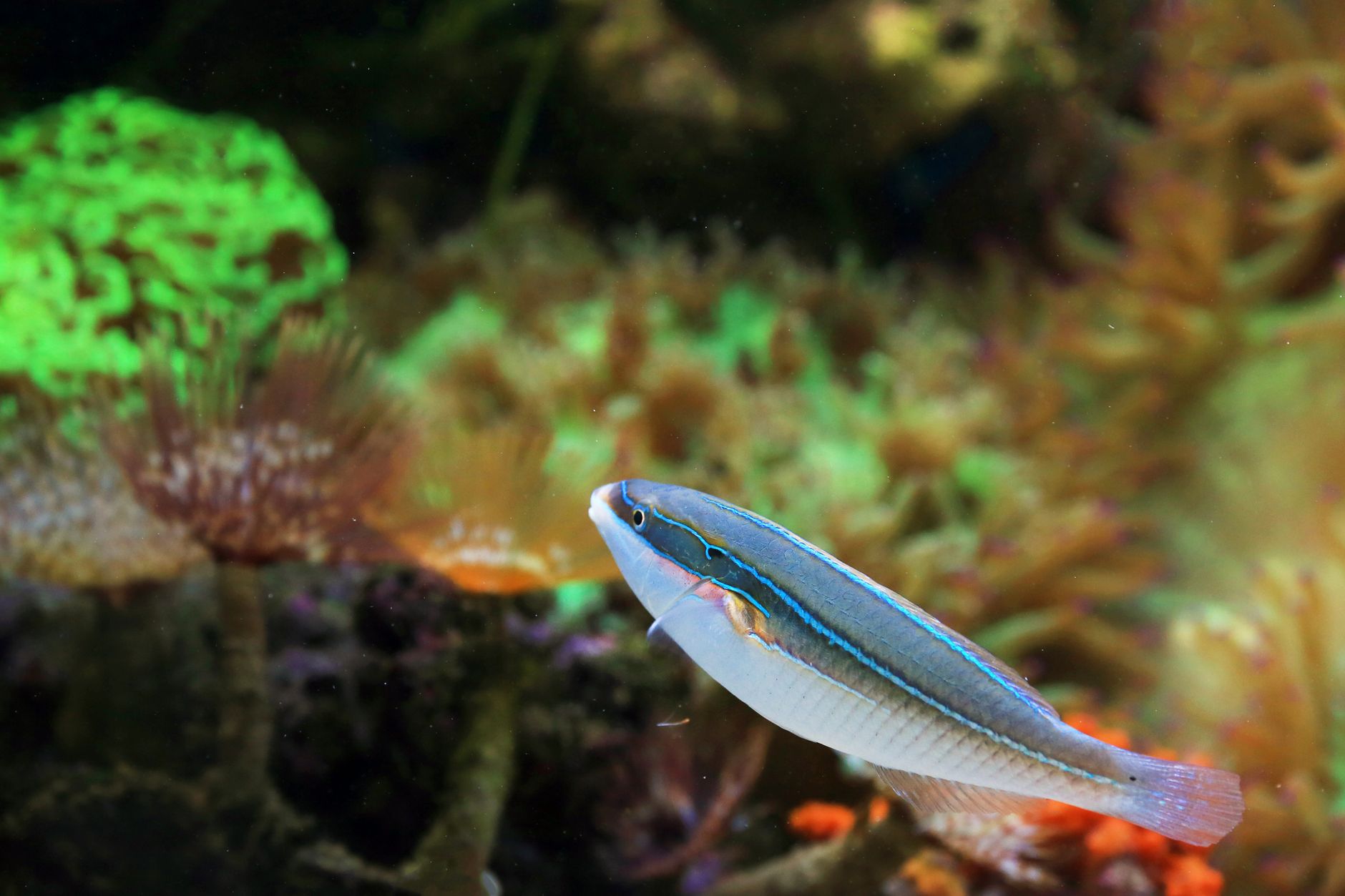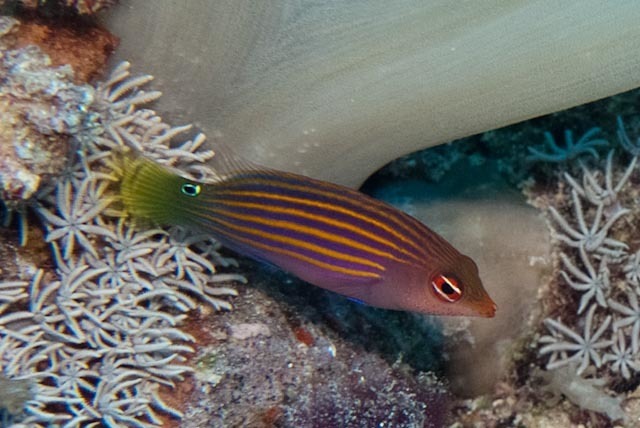
The six line wrasse, known scientifically as Pseudocheilinus hexataenia, is a small but bold reef fish from the Indo-Pacific. It stays around 3 inches long, making it a common choice for 30-gallon saltwater tanks. The fish is easy to recognize by its bright blue and orange stripes. Still, its bold personality can surprise keepers who expect a shy little wrasse. This care guide covers tank size, diet, compatibility, and daily maintenance so you can keep one healthy in 2026. It is not a beginner starter fish, but it can thrive with careful planning.
Before you bring a six line wrasse home, you need a mature saltwater tank. The fish depends on stable water chemistry and plenty of live rock. A new tank that has not finished the aquarium nitrogen cycle is dangerous for this species. Ammonia and nitrite spikes can kill a six line wrasse quickly. You also need to plan for its jumping habit and its strong opinions about tank mates. Rushing the setup is the most common route to failure.
A six line wrasse can be reef safe with caution. Many reef keepers add this fish to control pest flatworms and small bristle worms. But the same hunting instinct can lead it to eat small ornamental shrimp and crabs. That trade-off matters if you keep a mixed reef tank. Manage the risk by choosing tank mates carefully and providing frequent meaty meals. A well-fed wrasse is less likely to hunt tank inhabitants.
This guide walks through the key steps in order, from tank setup to long-term disease prevention. You will learn the exact water parameters, the best equipment, and how to introduce the fish without causing chaos. You will also see why a quarantine tank can save your display tank from disease. Follow the steps and you can enjoy this colorful wrasse for years.
What You’ll Need
- 30-gallon or larger saltwater aquarium with tight lid
- Live rock and protein skimmer
- Heater and thermometer
- Saltwater test kits and refractometer
- Quarantine tank setup
- Frozen mysis shrimp and other meaty foods
How Do You Care for a Six Line Wrasse?
- Set up a 30-gallon or larger tank with live rock
Six line wrasses stay small, usually about 3 inches long. Still, they need room to swim and hunt. A 30-gallon tank is the minimum for a single fish. Bigger tanks are better because they reduce stress and aggression. If you want to keep several reef fish, start with a 40-gallon breeder or a 55-gallon tank.
These fish come from Indo-Pacific reefs with dense rock structure. Fill the tank with live rock. Arrange the rock to create caves, overhangs, and narrow channels. A six line wrasse uses these spaces to hide, sleep, and hunt for small crustaceans. LiveAquaria notes that six line wrasses do best in tanks with plenty of live rock for hiding and grazing.
Leave some open swimming space in the front of the tank. Six line wrasses dart in and out of rockwork, but they also need room to cruise. Do not stack rock too close to the glass. You want water flowing through the rockwork and enough space for the fish to turn around.
Most important, use a tight-fitting lid. Six line wrasses are expert jumpers. A mesh screen top or a snug aquarium canopy can keep the fish from ending up on the floor. Even small gaps around filter tubes or heater cords can be escape routes.

- Cycle the tank before adding your wrasse
Never add a six line wrasse to an uncycled tank. The waste from a new fish can push ammonia and nitrite to deadly levels. Before you buy the fish, complete the nitrogen cycle. A fishless cycle with pure ammonia or a piece of raw shrimp works well. Our guide on how to cycle a fish tank shows the process step by step.
Once the cycle is done, give the tank time to mature. A six line wrasse is a natural hunter. It will pick at copepods, amphipods, and other microfauna on live rock. Let the tank run for several weeks after the cycle finishes. This gives small pods a chance to multiply. A mature tank also has more stable water chemistry.
Test the water before you go to the fish store. Ammonia and nitrite should read zero. Nitrate should stay below 20 ppm. Use a liquid saltwater test kit for accurate readings. If any ammonia or nitrite shows up, wait and dose more nitrifying bacteria. Do not rush this step.
A stable cycle is the foundation for the next step. The tank can then hold steady saltwater parameters without dangerous swings.
- Maintain stable saltwater parameters
Six line wrasses tolerate a range of conditions, but stability matters most. Keep the temperature between 72 and 78 degrees Fahrenheit. That is about 22 to 26 degrees Celsius. The pH should stay between 8.1 and 8.4. Salinity should be 1.020 to 1.025 specific gravity, with 1.025 being ideal for most reef tanks.
Use a reliable heater and a separate thermometer. A heater that fails can cook or chill the tank. You can read more about options in our best aquarium heaters for 2026 guide. Check the heater temperature daily at first. After that, check it during feedings.
Test salinity with a refractometer, not just a swing-arm hydrometer. Refractometers are more accurate and easy to use. Top off evaporation with fresh RO/DI water. Salt does not evaporate, so do not top off with saltwater. Small, frequent top-offs help keep salinity stable.
Change 10 to 20 percent of the water every one to two weeks. Use a gravel siphon to remove uneaten food and detritus. Our article on how often to change aquarium water explains why this matters. Consistent water changes keep nitrate low and trace elements available.
- Choose the right equipment: filtration, heat, and lighting
Good equipment makes six line wrasse care easier. Start with a quality protein skimmer. Saltwater tanks produce a lot of dissolved organic waste. A skimmer removes proteins before they break down into nitrate and phosphate. A hang-on-back skimmer or a sump skimmer works well. You can check the Reef Octopus Protein Skimmer on Amazon.
Filtration should also include live rock and mechanical media. A sump system with filter socks is common. If you use a hang-on-back filter, clean the media in old tank water every couple of weeks. Our best aquarium filters for 2026 guide covers choices that work for saltwater setups.
Heating is another key piece. Choose a heater rated for your tank size, about 3 to 5 watts per gallon. An Eheim Jager heater is a dependable option. You can check the Eheim Jager Aquarium Heater on Amazon. Use a controller or a high-quality thermostat to prevent overheating.
Lighting is not critical for the fish itself. Six line wrasses do not need intense light. But if you keep live rock or corals, choose a reef-capable LED fixture. Moderate light supports coralline algae and any easy corals. You can compare options in our best aquarium lighting for 2026 guide. Add a powerhead for flow. Aim for turnover of about 10 to 20 times the tank volume per hour.
- Quarantine the six line wrasse before the display tank
Quarantine every new fish, including six line wrasses. A separate quarantine tank helps you catch ich, velvet, and flukes before they enter your display. Aquarium Co-Op recommends a quarantine period of two to four weeks for new fish. This also lets the wrasse recover from shipping stress without competition.
Set up a simple quarantine tank. A 10-gallon or 20-gallon tank works for a six line wrasse. Add a sponge filter, a small heater, and PVC pipe fittings for hiding. Do not use live rock in quarantine because some medications can damage it. Match the salinity and temperature to your display tank.
Observe the fish daily. Look for white spots, rapid gill movement, cloudy eyes, or unusual swimming. If you see symptoms, treat in the quarantine tank. Our guide on how to treat ich in an aquarium can help you choose the right treatment. Do not treat a display tank with live rock and invertebrates.
After quarantine, acclimate the wrasse slowly to the display. Float the bag, then drip acclimate for 30 to 45 minutes. Turn off the display lights for the first few hours. This reduces stress and gives the fish time to find a hiding spot.
Important: Do not use copper in a display tank. Copper can kill live rock microfauna, corals, and invertebrates. Keep all medications out of the main tank unless the label says they are reef safe.
- Feed a varied meaty diet on a consistent schedule
Six line wrasses are carnivores. In the wild they eat small crustaceans, worms, and other meaty foods. Feed a varied diet built around frozen mysis shrimp. Brine shrimp, chopped clam, krill, and marine pellets can round out the menu. Avoid feeding only one food. Variety prevents nutritional gaps.
Feed small amounts twice a day. A six line wrasse has a fast metabolism and likes to graze throughout the day. Give only what the fish can eat in about two minutes. Overfeeding leads to algae problems and high nitrate. You can check San Francisco Bay Frozen Mysis Shrimp on Amazon.
Target feeding helps shy or bullied wrasses get enough food. Use a turkey baster or pipette to place food near the fish’s hiding spot. Some keepers also feed live copepods to encourage natural hunting. Live foods can be added occasionally, but do not rely on them as the only source of nutrition.
Rinse frozen food in a fine net before feeding. This removes excess phosphates from the packing water. It helps keep water quality high. Remove any uneaten food with a siphon or turkey baster after a few minutes.

- Choose compatible tank mates and manage aggression
Six line wrasses have a feisty personality. They are usually fine with larger, active fish. But they can bully small, peaceful tank mates. Avoid keeping them with dartfish, firefish, small gobies, or fairy and flasher wrasses. The six line wrasse may chase these fish and stop them from eating.
Better tank mates include clownfish, dwarf angelfish, cardinalfish, and larger tangs in a suitably big tank. For example, a mated pair of ocellaris clownfish can hold their own. Avoid other wrasses, especially another six line wrasse. Two six line wrasses will fight unless they are a known mated pair in a very large system.
Add the six line wrasse last whenever possible. Adding it last gives existing fish time to establish their territories. The wrasse then finds its own space instead of guarding a whole tank. If you must add new fish after the wrasse, rearrange the rockwork first. This resets territories and gives newcomers a fair start.
Watch for chasing, nipped fins, or fish hiding near the surface. If aggression appears, use a fish trap to remove either the wrasse or the victim. Do not wait until a fish stops eating. Early separation saves both fish.

- Watch for disease and perform routine maintenance
Check your six line wrasse every day. Healthy fish have clear eyes, smooth skin, and an active appetite. Watch for small white spots, which can be marine ich. Also look for velvet, which looks like a fine gold or gray dust on the body. Rapid breathing, scratching on rock, or hiding more than usual are red flags.
Test the water weekly. Keep ammonia and nitrite at zero and nitrate below 20 ppm. Record your results so you can catch trends. A sudden pH or temperature swing can weaken the fish and bring on disease. If something tests off, use small water changes to correct it slowly.
Clean the glass, siphon the substrate, and rinse filter media in old tank water. Do not scrub live rock or replace all filter pads at once. This can remove too much beneficial bacteria. Focus on removing waste, not on making the tank spotless.
Keep in mind that a six line wrasse can live five to eight years with good care. That is a long-term commitment. Stable conditions, varied food, and low stress are the keys. If disease does appear, act fast and treat in a quarantine tank.
Red Flags & Warnings
- 🚨 Do not keep two six line wrasses in the same tank unless you have a very large system and can confirm a mated pair. They will fight to the death.
- 🚨 Never add a six line wrasse to an uncycled tank. Ammonia and nitrite spikes can kill this sensitive reef fish within hours.
- 🚨 Do not trust a loose or open top. Six line wrasses are expert jumpers and will escape through small gaps.
- 🚨 Be cautious in reef tanks with small ornamental shrimp and crabs. This fish may hunt and eat them.
- 🚨 Do not house a six line wrasse with small, peaceful gobies, dartfish, or fairy wrasses. It can bully and stress them until they stop eating.
- 🚨 Avoid using copper-based medications in a display tank with live rock or invertebrates. Treat fish in a separate quarantine tank instead.
Frequently Asked Questions
What size tank does a six line wrasse need?
A single six line wrasse needs at least a 30-gallon tank. Larger tanks of 40 to 55 gallons are better because they reduce territorial aggression. The fish grows to about 3 inches, but it needs room to swim and hunt.
Are six line wrasses reef safe?
Six line wrasses are mostly reef safe with caution. They usually do not bother corals, but they may eat small ornamental shrimp, crabs, and bristleworms. Avoid keeping them with tiny decorative crustaceans you want to protect.
What do six line wrasses eat?
Six line wrasses are carnivores. Offer frozen mysis shrimp, brine shrimp, chopped clam, krill, and marine pellets. Feed small amounts twice a day. They also hunt copepods and amphipods living on live rock.
Can you keep two six line wrasses together?
Do not keep two six line wrasses together unless you have a very large system and a known mated pair. Two males or two females will fight aggressively. One fish should be the only six line wrasse in most home aquariums.
How do I stop a six line wrasse from jumping?
Use a tight-fitting mesh screen top or a snug aquarium canopy. Six line wrasses are expert jumpers and can fit through small gaps. Cover all openings around filter tubes, heater cords, and powerheads.
Are six line wrasses aggressive toward other fish?
They can be semi-aggressive, especially toward small, peaceful fish and other wrasses. They may chase dartfish, firefish, and fairy wrasses. Add the six line wrasse last and choose active tank mates that can hold their own.
What Should You Remember?
- Tank size: Set up at least a 30-gallon tank with plenty of live rock caves.
- Water parameters: Keep temperature at 72-78°F, pH 8.1-8.4, and salinity 1.020-1.025.
- Diet: Feed frozen mysis, brine shrimp, and other meaty foods twice daily.
- Tank mates: Avoid small timid fish, other wrasses, and a second six line wrasse.
- Jump prevention: Use a tight-fitting lid or mesh screen top at all times.
- Quarantine: Always quarantine new arrivals for 2 to 4 weeks before adding them to the display.
This article is for general information only and is not a substitute for professional veterinary or aquarium specialist advice. Always research the specific needs of your fish and consult an expert before making care decisions.