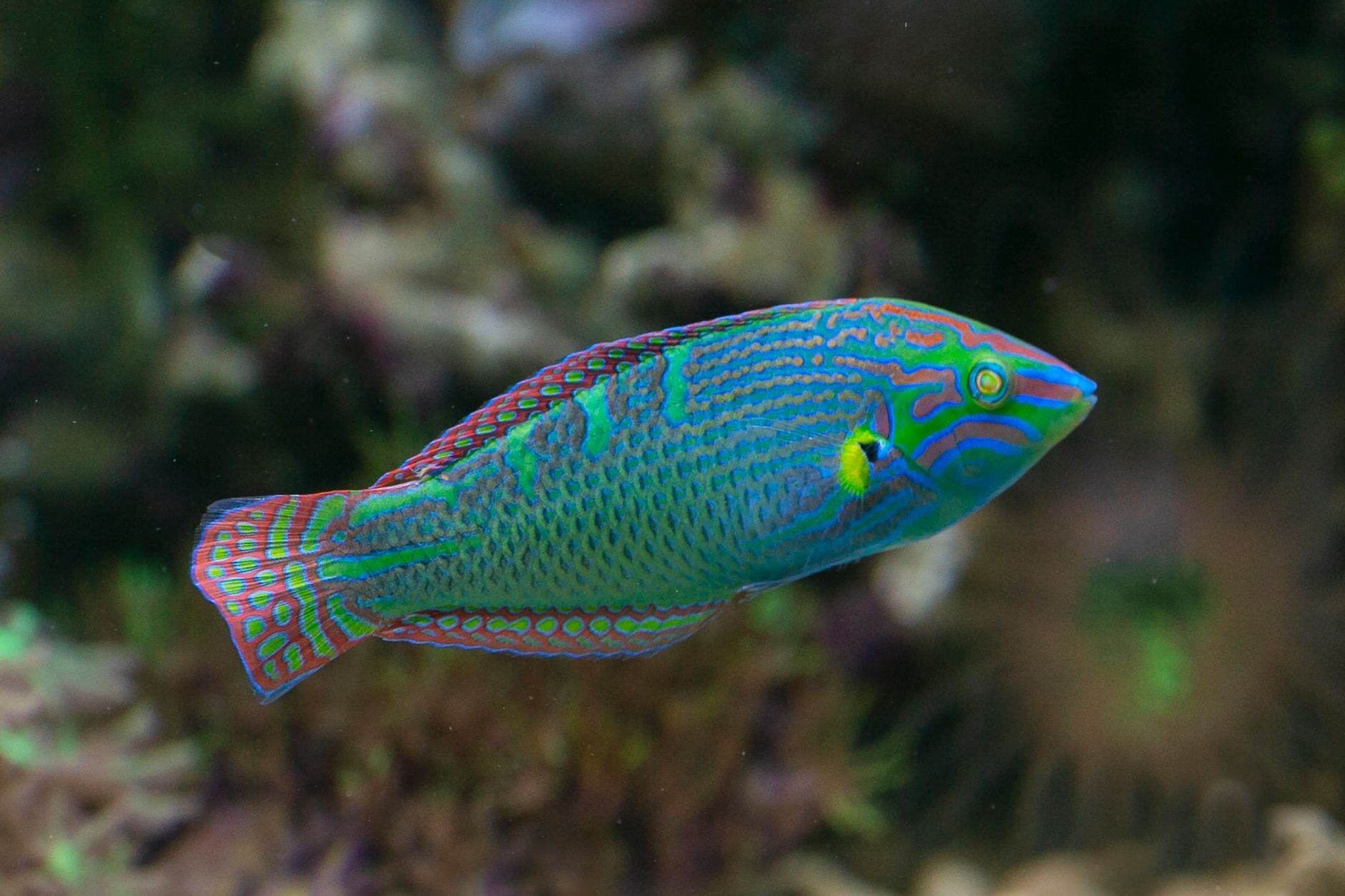
The leopard wrasse (Macropharyngodon meleagris) is one of the most beautiful and interesting fish you can add to a saltwater aquarium. Its intricate pattern of blue, green, and orange spots on a white or cream body makes it a showpiece. But this beauty comes with a reputation for being challenging, especially when it comes to feeding. Before you bring one home, you need to understand what this fish requires. A thorough understanding of the aquarium nitrogen cycle is essential, but leopard wrasse care goes far beyond cycling a tank.
Leopard wrasse are naturally shy and spend much of their time cruising live rock and sand in search of small invertebrates. They are not aggressive and do best in a peaceful community tank. One critical behavior is burrowing: every night, and whenever stressed, they dive into the sand to hide. That means your tank must have a deep, fine sand bed. Without it, the wrasse can injure its skin and become stressed, which often leads to disease and refusal to eat.
The biggest challenge with leopard wrasse is getting them to eat in captivity. In the wild, they feed constantly on tiny pods and crustaceans. In a new aquarium, they may ignore prepared foods entirely. That is why many experienced aquarists recommend feeding live foods first and slowly weaning the fish onto frozen alternatives. If you are not prepared to offer multiple small meals a day and source live food, a leopard wrasse may not be the right choice. This guide will walk you through every step, from tank setup to long-term health.
This article covers tank size, water parameters, quarantine, diet, compatibility, and more. We will reference authoritative sources like Aqueon for general saltwater care standards. We also include links to equipment guides such as best aquarium filters and best aquarium heaters to help you build the right system. By the end, you will know exactly how to give a leopard wrasse the best chance to thrive.
What You’ll Need
- Aquarium of at least 75 gallons with a secure lid
- Fine sand substrate (2 to 3 inches deep)
- Live rock for hiding and pod growth
- Protein skimmer
- Aquarium heater and thermometer
- Test kits for ammonia, nitrite, nitrate, pH, and salinity
- Live foods (blackworms, adult brine shrimp) and frozen mysis shrimp
How Do You Care for Leopard Wrasse?
- Start with a 75-gallon tank and a deep sand bed
Leopard wrasse need space. A single adult can reach 6 inches in length, and they are active foragers that cover a lot of area. A 75-gallon aquarium is the minimum; larger is better if you plan to keep a pair or add other fish. The tank should have a secure lid because wrasse are known jumpers, especially when startled.
The substrate is just as important as the tank size. Leopard wrasse bury themselves in sand to sleep and to escape stress. Use a fine grain sand, not crushed coral or coarse aragonite, because coarse grains can scratch their skin and cause infections. Aim for a sand bed depth of 2 to 3 inches. This allows the fish to completely disappear when it feels threatened or when the lights go out.
Live rock is essential for two reasons: it provides hiding places and it harbors tiny pods that leopard wrasse naturally hunt. Arrange the rock to leave open sand areas. Do not pack the rockwork tightly against the glass. The wrasse needs clear swimming lanes and areas to bury itself without obstruction. Proper aquascaping also helps reduce territorial disputes with other fish.
Before adding any fish, make sure the tank is fully cycled. Use a reliable test kit to check ammonia and nitrite at zero and nitrate below 20 ppm. You can read how to cycle a fish tank for a step-by-step process. You also need a protein skimmer to handle the bioload of a carnivorous fish. Check the protein skimmer on Amazon for a good option. A properly cycled, stable tank gives your leopard wrasse the best start.

- Maintain stable temperature, salinity, and pH
Stability is the key to keeping leopard wrasse healthy. These fish do not tolerate sudden swings in water parameters. The ideal temperature range is 72 to 78 degrees Fahrenheit. Keep pH between 8.1 and 8.4. Specific gravity should stay between 1.023 and 1.025. Use a high-quality heater and a reliable salinity meter or refractometer. Fluctuations of more than a degree or two in a day can stress the fish and suppress its immune system.
Ammonia and nitrite must always read zero. Nitrate should stay below 20 ppm, and lower is better. Regular water changes of 10 to 15 percent every two weeks help maintain these levels. Your protein skimmer will also remove dissolved organics before they break down into nitrate. Test your water weekly, not just when something looks wrong. Kits for ammonia, nitrite, nitrate, pH, and alkalinity are essential. Check the aquarium test kit on Amazon to find a comprehensive option.
Calcium and alkalinity are less critical for fish than for corals, but stable values still help overall health. Maintain alkalinity around 8 to 9 dKH and calcium between 380 and 420 ppm if you have a reef tank. Leopard wrasse are not coral eaters, but they live in the same water. An alkalinity drop can signal broader instability that will affect the fish. The Aqueon saltwater guide provides a good reference for baseline parameters.
A major mistake many new keepers make is chasing perfect numbers by adding chemicals too quickly. That causes swings that are worse than slightly off values. Make changes slowly. If you need to adjust salinity, do it over several hours. If temperature is low, raise it no more than one degree per hour. The leopard wrasse will reward you with better color and appetite when the water stays boringly stable. To learn more about how water quality affects fish, see the nitrogen cycle guide.
- Quarantine new leopard wrasse for at least 4 weeks
Leopard wrasse are notorious for arriving with internal parasites and external infections. A quarantine period is not optional. Set up a separate 10 to 20 gallon tank with a simple sponge filter, heater, and some PVC pipes for hiding. Use water from your display tank to match parameters. Do not put new fish directly into your main system.
Observe the wrasse closely during quarantine. Look for rapid breathing, white spots, cloudy eyes, or clamped fins. Many leopard wrasse come in with flukes or ich. Treating in a separate tank is much easier and safer than medicating a full reef. You can read how to treat ich in aquarium for specific medication protocols. Never use copper on a wrasse without proper testing; some species are sensitive to copper. Praziquantel is a good choice for flukes.
Use the quarantine time to get the wrasse eating before it faces competition in the main tank. Offer live foods on day one. Once it is eating reliably, slowly introduce frozen mysis. A fish that eats in quarantine has a far better chance in the display. Quarantine also lets you catch a non-feeding fish early. You can intervene with different live foods or garlic additives without the stress of tank mates.
After four weeks of good health and solid eating, the wrasse is ready to move. Acclimate it slowly to the display tank using a drip line for at least 30 minutes. Do not pour quarantine water into the main tank. Net the fish gently and release it near the rockwork. Turn off the lights for the first few hours to reduce stress. The wrasse will likely bury itself immediately; that is normal.

- Feed small, frequent meals of meaty foods
Diet is the number one reason leopard wrasse fail in captivity. These fish are micro-predators. In the wild they graze all day on copepods, amphipods, and small worms. Your job is to replicate that as closely as possible. Start with live foods like adult brine shrimp, blackworms, or white worms. Live foods trigger a feeding response that frozen foods often do not.
Feed small amounts three times a day. Overfeeding at one time can pollute the water, but underfeeding leads to starvation. A juvenile leopard wrasse can lose weight quickly. Watch the fish’s belly. It should look rounded after a meal, not sunken. If the wrasse ignores frozen food, keep offering live food until it is consistently eating. Then mix a little frozen mysis or chopped clam in with the live food. Gradually increase the frozen ratio over two to three weeks. Check the frozen mysis shrimp on Amazon for a convenient option.
Some leopard wrasse will also accept high-quality pellet or flake food designed for carnivores. Do not rely on these as a sole diet, but they can be useful for automatic feeders if you are away. Enriched brine shrimp and mysis with omega-3 fatty acids are excellent. You can also add a drop of garlic extract to frozen foods to stimulate appetite. Avoid overfeeding brine shrimp without enrichment; they are not nutritious enough as a staple.
The feeding challenge is similar to keeping a mandarin fish, which also depends on live pods. Unlike a mandarin, a leopard wrasse can often be weaned onto frozen foods. But you must be patient. Never force the fish to go hungry in hopes it will eat frozen. That usually ends badly. If you are struggling, try live blackworms from a reputable source. They are irresistible to most wrasse.
- Choose peaceful tank mates and avoid bullies
Leopard wrasse are peaceful and shy. They will not compete well with aggressive or fast-moving fish. Good tank mates include other peaceful wrasses like flasher wrasse, small gobies, blennies, cardinalfish, and clownfish. Ocellaris clownfish are an excellent choice because they occupy a different niche and do not bother wrasse. Banggai cardinalfish are also calm and ignore the wrasse.
Avoid fish that will outcompete the leopard wrasse for food or harass it. Triggers, puffers, large dottybacks, and aggressive damselfish are bad choices. Even peaceful but fast eaters like anthias can be a problem because they will grab all the food before the wrasse gets any. If you keep anthias or chromis, feed the wrasse on the opposite side of the tank with a pipette or baster.
Other wrasses can be compatible, but be careful with six-line wrasses. A six-line wrasse can become territorial and may bully a leopard wrasse. Similarly, cleaner wrasses may pester leopard wrasse for parasites. If you want another wrasse, consider a flasher or fairy wrasse. They are less likely to compete directly. Always provide multiple hiding spots and feeding stations.
In a community tank, introduce the leopard wrasse before known aggressive fish or after peaceful fish have settled. The more established the wrasse feels, the better it will eat and come out. If you notice the wrasse hiding constantly or losing weight, remove the aggressive tank mate or move the wrasse to a separate refugium. Health and feeding are always more important than the community mix.

- Protect burrowing behavior with fine sand and gentle lighting
Leopard wrasse bury themselves every night and whenever they feel threatened. This behavior is non-negotiable. If the sand is too coarse or too shallow, the fish will hurt itself trying to dig. A fine grain sand of 2 to 3 inches deep is essential. Do not use crushed coral, aragonite gravel, or bare bottom tanks. A bare bottom will stress the wrasse to the point of illness.
Lighting also matters. In the wild, sunset triggers burrowing. In your tank, sudden lights-off can startle the wrasse and cause it to crash into rocks. Use a dimmable LED light or a ramp timer that gradually decreases intensity. Check the aquarium lighting on Amazon for a programmable option. A short period of blue or moonlight before darkness helps the fish settle naturally.
When the wrasse is buried, do not disturb it. Do not vacuum the sand directly over the fish. Do not use a powerhead pointed at the sand bed that could uncover it. If you need to clean the sand, do so gently in sections over several days. A buried leopard wrasse is not dead; it is sleeping or hiding. It will emerge when it feels safe.
During the first week in a new tank, the wrasse may stay buried for long periods. That is normal. Do not dig it out. The more you interfere, the longer it will hide. Provide plenty of live rock caves and dim lighting to encourage exploration. After a few days, it should start cruising for food. If it stays buried for more than three days, check water parameters and look for signs of disease.
- Monitor for stress, parasites, and starvation
Leopard wrasse are sensitive to stress. Stress weakens their immune system and makes them vulnerable to disease. Watch your fish daily. Healthy signs include a rounded belly, clear eyes, active swimming, and regular burrowing at night. Warning signs include clamped fins, rapid breathing, hiding for days, white spots, faded colors, and a sunken belly.
Weight loss is often the first sign of a feeding problem. If the wrasse is not eating enough, its belly will look pinched behind the head. Do not wait until it is emaciated to intervene. Increase feeding frequency or change the food type. Live blackworms or enriched brine shrimp often revive appetite. If the fish stops eating entirely, it may have internal parasites. Treat in quarantine with praziquantel under veterinary guidance.
Common external parasites include ich and flukes. Ich appears as small white spots like salt grains. Flukes are harder to see but cause scratching against rocks and rapid breathing. For detailed treatment, refer to how to treat ich in aquarium. Never use copper in a reef tank. Always treat sick fish in a separate hospital tank. Temperature and salinity must remain stable during treatment.
A sudden change in behavior, such as staying out in the open at night or swimming erratically, can indicate poor water quality or aggression from tank mates. Test the water immediately. Check for ammonia spike or temperature swing. Observe interactions with other fish. The leopard wrasse may be getting bullied even if you do not see it. Sometimes the bully strikes at night. If necessary, separate the aggressor.
- Respect their shy nature and avoid overhandling
Leopard wrasse do not like to be chased or handled. Avoid netting them unless absolutely necessary. Their delicate scales and skin can be damaged easily. When you must move the fish, use a clear container to scoop it rather than a net. A container reduces stress and prevents injury. This is especially important when transferring from quarantine to display.
Never try to pet or interact with the wrasse physically. Some fish recognize their owners, but leopard wrasse are more skittish. Sudden movements near the tank can send them diving into the sand. Keep the tank in a low-traffic area if possible. If children or pets like to tap the glass, that stress will accumulate. A stressed wrasse may stop eating and hide for weeks.
Even though leopard wrasse are reef safe with caution, they will eat small snails, bristleworms, and other microfauna. That is usually beneficial, but if you prize ornamental snails, know they may become snacks. The wrasse will not harm corals, anemones, or clams. However, its burrowing can bury low-lying corals placed on the sand. Keep corals on rocks or elevate them on frag plugs.
Finally, understand that some leopard wrasse simply never adjust to captivity. Despite your best efforts, the fish may refuse all food and waste away. This is why so many aquarists consider them an expert-only species. Do not blame yourself. Learn from the experience and perhaps try another individual after making adjustments. The most important thing is to provide the best possible environment and diet from day one. If you have followed this guide, you have given your leopard wrasse every chance to thrive.
Red Flags & Warnings
- 🚨 Never add a leopard wrasse to a newly cycled tank with unstable parameters. Wait until ammonia and nitrite are zero and nitrate is below 20 ppm.
- 🚨 Do not keep leopard wrasse with aggressive or fast-swimming fish that outcompete them for food. Triggers, large dottybacks, and some damsels are bad choices.
- 🚨 Avoid coarse substrate. Crushed coral or large grain aragonite can scratch the wrasse’s skin when it burrows, leading to infections.
- 🚨 Do not skip quarantine. Leopard wrasse often arrive with internal parasites or ich. Treating in a separate tank is safer for the fish and your display.
- 🚨 Be prepared to offer live foods initially. A new leopard wrasse may refuse frozen or dry foods for weeks. Do not starve it into submission.
Frequently Asked Questions
What size tank does a leopard wrasse need?
A minimum of 75 gallons is recommended for a single leopard wrasse. They are active swimmers and need ample space to forage. Larger tanks are always better, especially if you plan to keep more than one or with other fish.
Are leopard wrasse reef safe?
Leopard wrasse are generally considered reef safe with caution. They will not harm corals or most invertebrates, but they may eat small snails and bristleworms. Their burrowing behavior can disturb sand-dwelling corals placed on the substrate.
What do leopard wrasse eat?
Leopard wrasse are carnivorous and prefer small meaty foods. In the wild they eat copepods, amphipods, and small crustaceans. In the home aquarium, start with live foods like blackworms or enriched brine shrimp, then transition to frozen mysis, chopped clam, and other meaty preparations.
Can leopard wrasse live with clownfish?
Yes, leopard wrasse generally coexist well with clownfish. Clownfish are not aggressive toward wrasse and do not compete heavily for food. However, avoid hosting clownfish that become territorial around anemones. Ensure the leopard wrasse gets its share at feeding time.
How long do leopard wrasse live?
With excellent care, leopard wrasse can live 5 to 7 years in captivity. Longevity depends heavily on diet, water quality, and avoiding stress. Many do not survive the first few months due to feeding difficulties, so patience and preparation are key.
Why is my leopard wrasse burying itself?
Leopard wrasse bury themselves in sand to sleep at night and to escape stress. It is completely normal behavior. Provide a fine sand bed at least 2 to 3 inches deep. If the wrasse hides for days, check water parameters and tank mates for stressors.
How do I get a leopard wrasse to eat?
Start with live foods like adult brine shrimp or blackworms. Offer small meals multiple times a day. Once the wrasse is eating live foods, mix in frozen mysis or other frozen items. Garlic extract can sometimes stimulate appetite. Never starve a new leopard wrasse; be patient.
What Should You Remember?
- Tank size: Provide at least a 75-gallon aquarium with a tight-fitting lid.
- Substrate: Use fine sand 2 to 3 inches deep for burrowing and sleeping.
- Water parameters: Maintain 72-78°F, pH 8.1-8.4, and salinity 1.023-1.025.
- Diet: Feed small meaty foods two to three times daily, starting with live items.
- Tank mates: Choose peaceful species only; avoid aggressive or fast-swimming bullies.
- Quarantine: Always quarantine new leopard wrasse for at least 4 weeks.
- Observation: Monitor for signs of stress, parasites, and weight loss daily.
This article is for general information only and is not a substitute for professional veterinary or aquarium specialist advice. Always research the specific needs of your fish and consult an expert before making care decisions.