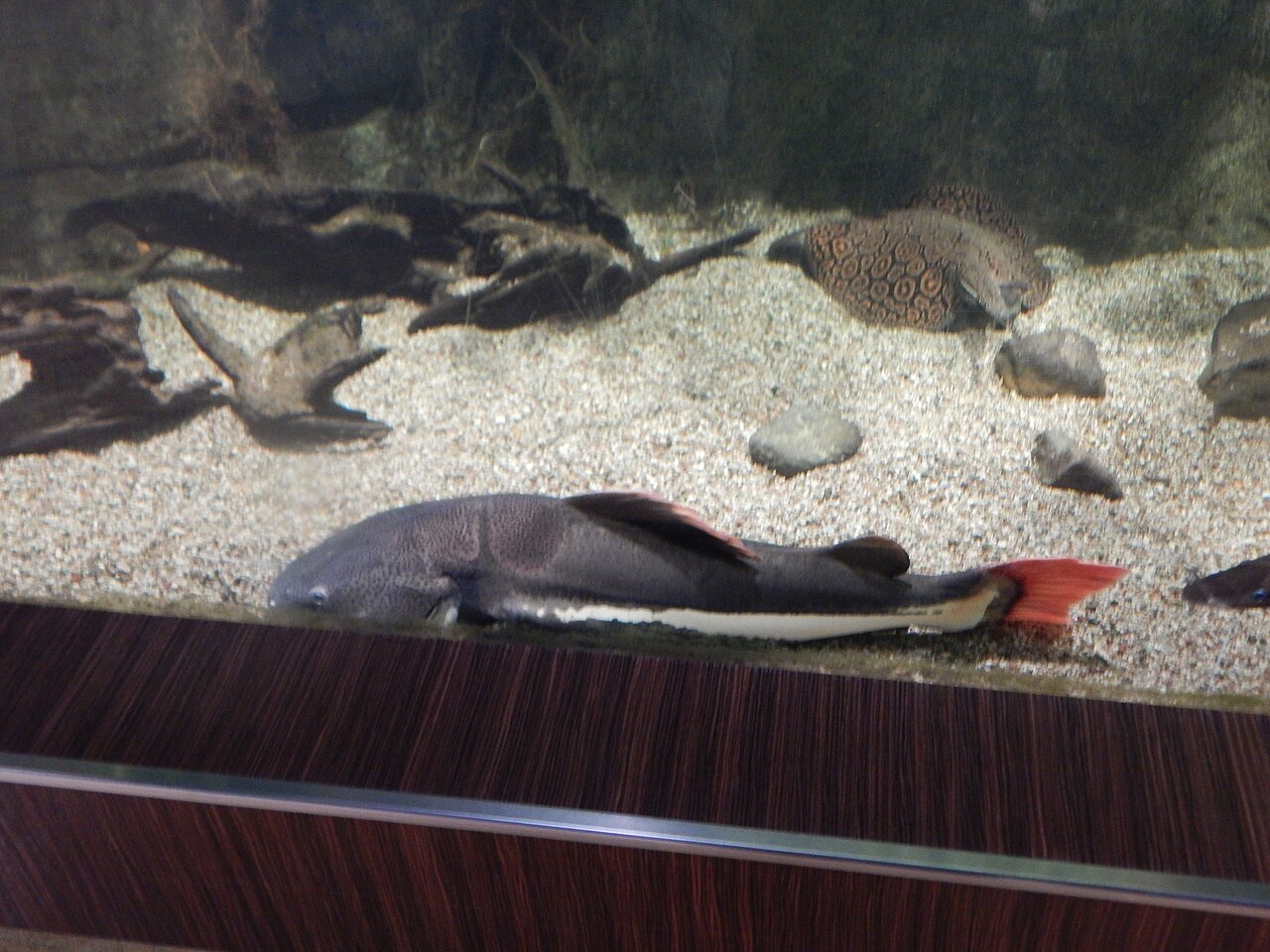
Redtail catfish (Phractocephalus hemioliopterus) look adorable as 2-inch juveniles in a dealer tank, but they grow into one of the largest freshwater fish available to hobbyists. A full-grown redtail can reach 3 to 4 feet long and weigh over 80 pounds. This guide explains what that growth means for your tank, your filter, and your stocking choices. Do not buy one before you read every section carefully.
The basics are simple but demanding. These South American predators need warm water, heavy filtration, and an enormous footprint. According to Seriously Fish, redtail catfish come from the Amazon and Orinoco basins, where they patrol deep river channels. In captivity they accept prepared foods, but their bioload is extreme. You will need to master the aquarium nitrogen cycle before bringing one home.
Too many redtails are sold without a warning label. They quickly outgrow 75-gallon and even 300-gallon setups. The 2026 fishkeeping hobby has better equipment, but no filter turns a small tank into a river. This guide covers each step from first setup to long-term health and shows you what it really takes to keep this giant responsibly.
Plan for a 1,000-gallon or larger system if you want to keep an adult redtail catfish responsibly. You will also need a high-capacity filter, a strong heater, and a secure lid. We will cover these pieces below. For filter options, start with best aquarium filters 2026. Then follow the seven steps in order.
What You’ll Need
- 1,000-gallon aquarium or indoor pond for adults
- Heavy-duty canister filter or sump with 8-10x turnover
- Two or three submersible heaters and a digital thermometer
- Liquid water test kit for ammonia, nitrite, nitrate, and pH
- Python-style siphon or large water pump
- Sturdy lid or netting
- Sinking carnivore pellets and frozen whole foods
- Water conditioner and dechlorinator
How Do You Care for Redtail Catfish?
- Accept the Adult Size Before You Bring One Home
A redtail catfish sold at 2 inches will reach 1 foot within the first year under good care. By year three it may be 2 to 3 feet long. This is not a slow grower. Adult size is 3 to 4 feet, with some specimens over 4 feet. That means a standard 55 or 125 gallon tank is not a long-term home.
Before buying, measure the space you can dedicate. A 1,000-gallon tank is about 10 feet long, 4 feet wide, and 3 feet tall. An indoor pond or large stock tank is often more practical. Check floor load if the tank will be upstairs. Aquarium Co-Op cautions that monster fish require dedicated fish rooms or reinforced floors because water alone weighs over 8 pounds per gallon.
Think about long-term commitment too. Redtail catfish can live 15 to 20 years or more in proper conditions. You must plan for feeding, water changes, and possible rehoming. If you cannot commit to an adult giant, choose a smaller catfish instead. Consider a common pleco care guide as a similar but more manageable bottom dweller, though it also needs space.

- Choose a Giant Tank or Indoor Pond with a Secure Lid
Start juveniles in a 150 to 300 gallon tank if you already have the adult upgrade planned. This gives you time to build the permanent system. However, do not use the juvenile tank as an excuse to delay. Many keepers are caught off guard by the growth rate.
For an adult, a 1,000-gallon aquarium or a large indoor pond is the minimum. Footprint matters more than height. Redtail catfish are active swimmers that need length and width to turn around. A narrow 1,000-gallon column is worse than a 600-gallon stock tank with good floor space.
Cover the tank completely. Redtail catfish sometimes bolt to the surface and can jump. Use a heavy, locked lid or netting. Keep equipment cords protected because these fish can knock heaters and filter intakes around. Smooth decor is best. Avoid driftwood with sharp points and rough rocks that can scrape the catfish belly.
Set the tank away from high traffic and bright light. Redtails can be shy when small. They become bolder as they grow. Low lighting and a sandy or bare bottom reduce stress. If you need help choosing a filter for this setup, see best aquarium filters 2026.

- Install Heavy-Duty Filtration and Heating
Redtail catfish produce massive amounts of waste. The filter should turn over the total tank volume at least 8 to 10 times per hour. For a 1,000-gallon aquarium, that means 8,000 to 10,000 gallons per hour of flow. A single canister filter like the Fluval FX6 canister filter on Amazon is great on smaller grow-out tanks, but adults need multiple large filters or a sump.
A sump system offers more biological media space and easier maintenance. You can hide heaters and pumps there. If you use a sump, size it for at least 20 to 30 percent of the display volume. Add mechanical filtration before the biological media to catch uneaten food.
Heating a giant tank takes planning. Redtail catfish need 75 to 82 degrees Fahrenheit. Use two or three submersible heaters rated for the total volume, not one oversized heater. This prevents a single failure from cooking or chilling the fish. A heater controller adds a safety cutoff.
Place filter outputs to create a moderate current. Redtails come from rivers and enjoy flow. But make sure there is a calm area where the fish can rest. Clean filter intakes weekly because large carnivores clog sponges quickly. That connection to maintenance will come in the final step.
- Maintain Warm, Soft, Slightly Acidic to Neutral Water
Redtail catfish do best at 75 to 82 degrees Fahrenheit, pH 6.0 to 7.5, and hardness between 5 and 12 dGH. They tolerate a range, but stability matters more than exact numbers. Large swings in pH or temperature stress them and open the door to disease.
Test the water weekly with a liquid test kit like the API Freshwater Master Test Kit on Amazon. Ammonia and nitrite must stay at 0 ppm. Nitrate should stay under 20 ppm. If nitrate climbs, increase water changes. For lowering pH, review how to lower pH in aquarium before using chemicals.
Heavy stocking and huge feedings cause rapid pH drops because of organic acids. Buffer the water naturally with crushed coral or aragonite in the filter if your tap water is very soft. In hard tap water, avoid adding shells or limestone. A stable pH between 6.5 and 7.2 is realistic for most keepers.
Temperature should be consistent. Use a digital thermometer and check it daily. During water changes, match the new water temperature to the tank within a degree or two. Cold water shocks a redtail and can cause clamped fins or ich. This connects to quarantine and health in the final step.
- Feed a Varied, High-Protein Carnivore Diet
Redtail catfish are opportunistic carnivores. In the wild they eat fish, crustaceans, insects, and fallen fruit. In captivity they need protein-rich foods. Use high-quality sinking carnivore pellets as the base. Check Hikari sinking carnivore pellets on Amazon are one option, but vary the diet.
Offer thawed shrimp, tilapia, earthworms, mussels, and occasional pieces of market squid. Avoid beef heart, chicken, and other mammal meat as staples because they are too fatty. Feed juveniles daily. Adults do well with feeding three to four times per week. Overfeeding causes obesity and water quality crashes.
Do not use live feeder goldfish or rosy red minnows as a staple. They carry parasites and thiaminase, which causes vitamin B1 deficiency over time. If you want to feed live fish, quarantine them first or raise your own safe feeders. Frozen or prepared foods are safer and more convenient.
Remove uneaten food after 15 to 20 minutes. Redtails are messy eaters that shred food and cloud the water. This waste is why compatibility and water changes matter. A feeding ring or target feeding helps keep food from scattering. Adjust portion sizes based on the fish’s girth, not begging behavior.

- Keep Redtail Catfish Solo or Choose Giant Tank Mates Carefully
The best tank mate for a redtail catfish is no tank mate. They will eat any fish that fits in their mouth, and their mouth is huge. Even peaceful fish can be swallowed at night. If you want a community, plan for species that are too large to eat and that can hold their own.
Possible tank mates include large arowana, giant gourami, pacu, large oscars, and other monster fish. Still, aggression and competition for food are real problems. An oscar care guide shows that oscars need 75 gallons themselves. Combine them only in a very large system with multiple hiding spots.
Avoid slow-moving fish, long-finned fish, and anything under 12 inches. Redtail catfish are crepuscular hunters. They may ignore a fish for months and then eat it. Also avoid plecos that can suck on the catfish slime coat, though large common plecos are sometimes kept with them if they have enough space.
If you try a mixed monster tank, have a backup plan. You may need to separate fish quickly. Keep a large divider or a second tank ready. Watch for torn fins, bite marks, and fish hiding constantly. In most cases, a solo redtail in a giant aquarium is less stressful for the keeper and the fish.
- Perform Large Weekly Water Changes and Health Checks
Redtail catfish need large, frequent water changes because of their bioload. Change 25 to 50 percent of the water weekly, depending on nitrate levels and stocking. If you keep other large fish, change 50 percent or more. Use a python-style siphon or a dedicated pump for large tanks. More on frequency in how often to change aquarium water.
Always use a dechlorinator when adding tap water. Test ammonia, nitrite, and nitrate before and after the water change. If the tank has not finished cycling, do not add a redtail catfish. Review the nitrogen cycle guide if needed. For new aquariums, follow a fishless cycling process before introducing any fish.
While changing water, inspect the fish. Look for white spots, red sores, frayed fins, or rapid breathing. Ich and bacterial infections are common in stressed giants. Treat with appropriate medications only after testing water, because poor water is often the root cause. Quarantine any new fish for at least four weeks before adding them to a redtail tank.
Watch for signs of stress like hiding, refusing food, or darting. Maintain a log of water parameters and feeding. This helps you spot trends before a crash. Clean filter media in old tank water, not tap water, to preserve beneficial bacteria. A routine is the best defense against giant fish problems.
Finally, never release a redtail catfish into local waterways. They become invasive and destroy native fish populations. If you can no longer care for it, contact a public aquarium or a monster fish rescue. Responsible rehoming is part of care.
Red Flags & Warnings
- 🚨 A redtail catfish is not a pet for a standard home aquarium. It reaches 3 to 4 feet and needs 1,000 gallons or more.
- 🚨 Never release a redtail catfish into a pond, river, or lake. It can become an invasive predator.
- 🚨 Do not feed live feeder fish as a staple. They can introduce parasites and cause vitamin B1 deficiency.
- 🚨 Use only smooth decor. Sharp rocks and rough driftwood can injure the catfish’s belly and barbels.
- 🚨 Do not skip water changes. Heavy feeding will spike ammonia and nitrite fast.
- 🚨 Secure the lid. Redtail catfish can jump and break glass or escape.
Frequently Asked Questions
How big do redtail catfish get?
Redtail catfish commonly reach 3 to 4 feet in captivity. Some specimens grow over 4 feet long and can weigh more than 80 pounds. They grow fast, often hitting 12 to 18 inches within the first year.
What size tank does a redtail catfish need?
Adult redtail catfish need at least 1,000 gallons. A large indoor pond or stock tank is usually more practical than a glass aquarium. Juveniles can start in 150 to 300 gallons but will quickly need an upgrade.
What do redtail catfish eat?
They are carnivores. Offer sinking carnivore pellets, thawed shrimp, tilapia, earthworms, and mussels. Avoid live feeder fish as a staple because of parasite and nutritional risks.
Can redtail catfish live with other fish?
They should be kept solo in most cases. They will eat any fish that fits in their mouth. If you keep tank mates, choose very large, fast fish like arowana or giant gourami in a huge system with a backup plan.
How fast do redtail catfish grow?
They can grow from 2 inches to 12 inches or more in the first year. Growth slows after they reach 2 to 3 feet, but they continue growing for years under good care.
Are redtail catfish good for beginners?
No. Redtail catfish demand an enormous aquarium, powerful filtration, and frequent large water changes. They are best left to experienced monster fish keepers with dedicated space and budget.
What Should You Remember?
- Tank size: Provide at least 1,000 gallons for an adult redtail catfish.
- Water quality: Keep ammonia and nitrite at 0 ppm, and change 25 to 50 percent weekly.
- Diet: Feed protein-rich sinking pellets and thawed whole prey, not live feeder fish.
- Compatibility: Keep redtail catfish solo or with only very large, fast tank mates.
- Filtration: Use a filter that turns over the tank 8 to 10 times per hour.
- Growth: Expect a 2-inch juvenile to reach 3 to 4 feet and live 15 to 20 years.
This article is for general information only and is not a substitute for professional veterinary or aquarium specialist advice. Always research the specific needs of your fish and consult an expert before making care decisions.