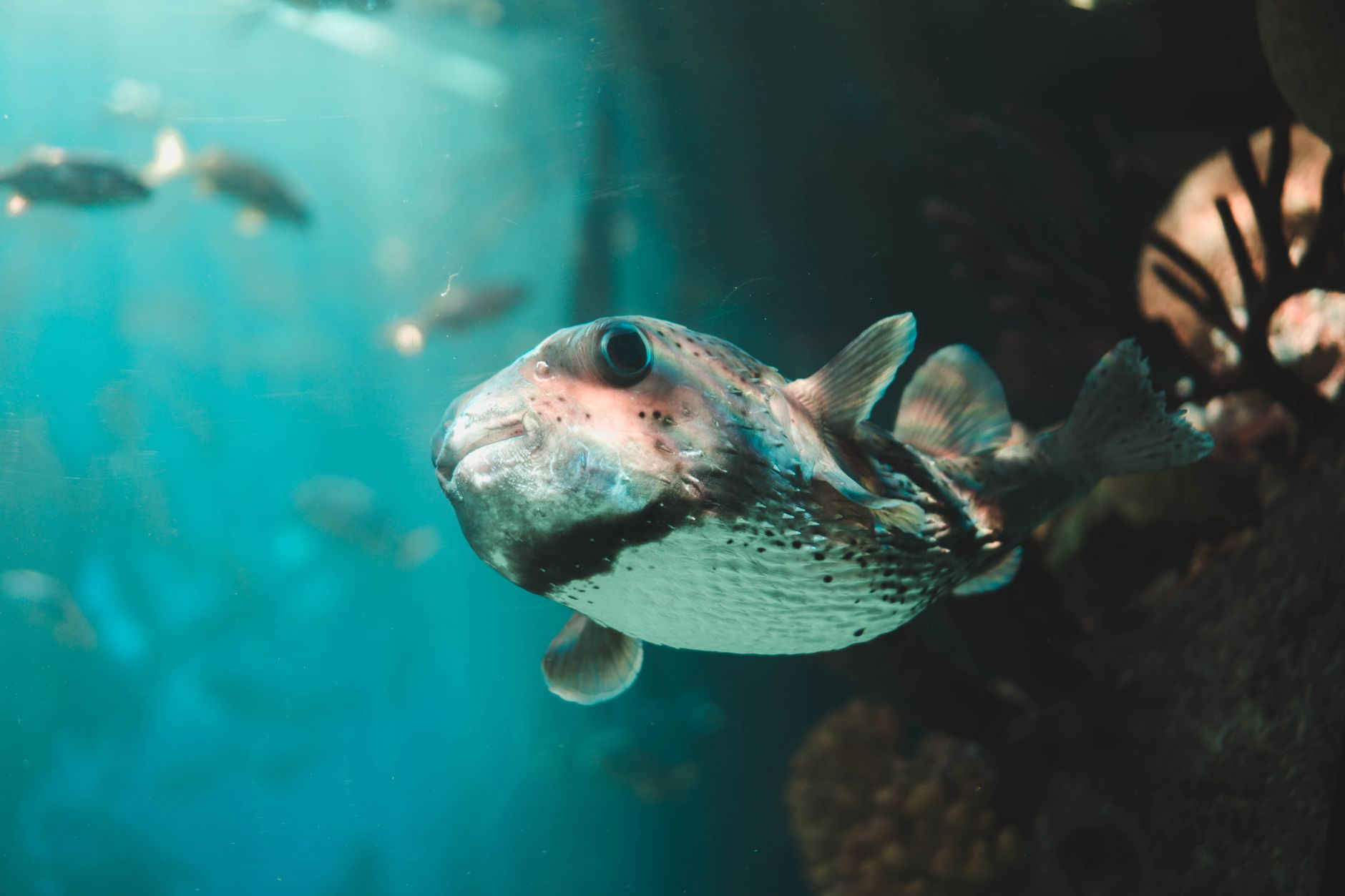
Porcupine pufferfish (Diodon holocanthus) are some of the most personable marine fish in the aquarium hobby. They learn to recognize keepers, beg for food, and even spit water at feeding time. But they are not a beginner species. These puffers grow large, eat constantly, and create a serious amount of waste. Before you bring one home, you need to understand the space, filtration, and feeding demands. A mature biofilter is also critical, so review our aquarium nitrogen cycle explained guide before you set up.
The two biggest mistakes new keepers make are choosing a tank that is too small and feeding too many soft foods. Porcupine puffers reach 12 to 20 inches in length, with most adults sitting around 14 to 16 inches. They need room to turn, swim, and hide. A 55-gallon tank will not work for long. Their beak-like teeth grow continuously. A diet rich in hard-shelled foods like clams, mussels, and shrimp keeps those teeth worn down. If the diet is too soft, the teeth can overgrow and stop the fish from eating.
Water quality is the next big hurdle. Porcupine puffers are messy eaters and produce large amounts of ammonia. That means you need strong biological filtration, a protein skimmer, and a strict maintenance schedule. If you have kept smaller marine fish, you may be surprised at how fast nitrates climb in a puffer tank. Stable saltwater parameters are just as important as tank size. The fish does not tolerate swings in salinity, pH, or temperature well. This guide covers everything you need to keep one healthy.
Finally, think about the long term. A well cared for porcupine puffer can live 10 years or more. That is a long commitment to a large, predatory fish. You also need to plan for a species-only tank or choose tankmates carefully. Many common reef fish and almost all ornamental invertebrates will become snacks. If you are ready for a big, interactive wet pet, keep reading. The steps below cover tank size, diet, setup, and ongoing care.
What You’ll Need
- 180-gallon or larger marine aquarium with sturdy stand
- Protein skimmer rated for 250+ gallons
- Canister or sump filter with mechanical and biological media
- Two aquarium heaters with controller
- Marine test kit for pH, ammonia, nitrite, nitrate, and salinity
- Refractometer or hydrometer
- Powerheads or wavemakers for circulation
- Aquarium feeding tongs
- Reverse osmosis deionized water source
- Large quarantine tank with sponge filter
How Do You Care for Porcupine Pufferfish?
- Start with a 180-Gallon or Larger Marine Tank
Porcupine pufferfish grow to an adult size of 12 to 20 inches in length, with many reaching 14 to 16 inches in home aquariums. That means the absolute minimum tank size is 180 gallons. A standard 180-gallon tank is 6 feet long, 2 feet wide, and 2 feet tall. This gives the fish enough room to turn around without wedging itself against the glass. For a fully grown adult, a 220-gallon or 240-gallon tank is even better. Do not start a juvenile in a 75-gallon tank and assume you will upgrade later. These fish grow fast, and stunting them in a small tank causes stress and disease.
The footprint matters more than total volume. A puffer needs horizontal swimming space more than height. A 125-gallon tank is long, but at 18 inches wide it is too narrow for a heavy-bodied adult puffer. Look for a tank with at least 6 feet of length and 24 inches of front-to-back depth. This allows the fish to glide, turn, and retreat to a cave without scraping its body. It also spreads waste across a larger water volume, which helps keep ammonia and nitrite levels stable.
Before you add the puffer, the tank must be fully cycled. A new 180-gallon system can take 4 to 8 weeks to establish a strong biofilter. Use a fishless cycling method to avoid exposing your puffer to toxic ammonia. Our how to cycle a fish tank guide walks through the process. The puffer should be one of the last fish added after the cycle is complete and the water parameters are stable.
Finally, place the aquarium on a stand that can support over 2,000 pounds of water and rock. A large tank, sump, and live rock add up quickly. Check the floor load and use a dedicated stand rated for the filled weight. Leveling the stand is critical too. An unlevel tank places dangerous stress on the seams and can lead to a catastrophic leak.

- Maintain Stable Saltwater Parameters
Porcupine puffers are marine fish, not brackish or freshwater. They need full saltwater with specific gravity between 1.020 and 1.025. The ideal temperature range is 72 to 78 degrees Fahrenheit, and pH should stay between 8.1 and 8.4. Ammonia and nitrite must always read zero. Nitrate should stay below 20 parts per million, although lower is better. Use a reliable aquarium test kit to track these levels weekly at first. Test kits with liquid reagents are more accurate than dip strips.
Stability matters more than chasing a single perfect number. If your salinity is 1.023, keep it there. A swing from 1.020 to 1.025 in one day is far more stressful than sitting at 1.024. Top off evaporated water with fresh reverse osmosis deionized water every day. Salt does not evaporate, so never top off with saltwater. Use an auto top off system or a manual routine to keep salinity steady. According to Aqueon, consistent water quality is the foundation of puffer health.
Use a quality heater with a controller to avoid temperature swings. A large tank needs at least two heaters placed at opposite ends. This creates even heat distribution and gives you a backup if one fails. Our best aquarium heaters 2026 article lists reliable options for large marine setups. Check the temperature daily with a digital thermometer or controller, not a stick-on strip. Puffers are sensitive to rapid drops in temperature, which often lead to ich.
Acclimate the puffer slowly when you first introduce it. Drip acclimation over 45 to 60 minutes is best. This allows the fish to adjust to your tank’s salinity, pH, and temperature without shock. Never pour bag water into the tank. Bag water may contain ammonia, pathogens, or old medications. Float the bag for temperature, then drip acclimate, then net the fish and place it into the display. Turn the tank lights off for the first few hours to reduce stress.

- Create a Puffer-Safe Aquascape with Caves and Open Space
Porcupine puffers are not open-water swimmers like tangs. They need caves, overhangs, and rock structures to retreat into when they feel threatened. Use live rock or dry rock to build a stable aquascape. Leave at least 18 to 24 inches of open swimming space in the front of the tank. These fish can be shy when first introduced. A cave gives them a safe place to hide while they adjust.
Be careful with sharp edges. Porcupine puffers have skin instead of scales, and they can scrape themselves on rough rock or coral skeletons. They also inflate when stressed, which makes their spines stand out. If the rockwork has sharp points, the puffer can tear its skin during inflation. Sand down rough edges or choose smooth, rounded rock. Place rock on the tank bottom before adding sand so it does not topple if the fish digs or bumps into it.
The puffer needs room to inflate safely. Do not fill every inch of the tank with rock. Leave at least half of the display as open water. A crowded tank increases stress and makes it hard for the fish to escape aggressive tankmates. It also traps uneaten food and waste in dead spots. Arrange powerheads to keep water moving through the rockwork without blasting the puffer against the glass.
Sandy substrate is best. Porcupine puffers may dig or rest on the bottom. A deep aragonite sand bed helps buffer pH and looks natural. Avoid sharp crushed coral, which can scratch the fish’s belly. If you want macroalgae in a refugium, keep it out of the display. The puffer will likely uproot or eat it. This setup step connects to filtration, because rock and sand provide the biological surface area for beneficial bacteria.
- Install Oversized Filtration and a Protein Skimmer
Porcupine puffers are some of the messiest eaters in the marine hobby. They tear food apart, drop pieces, and produce heavy waste. A hang-on-back filter rated for a 75-gallon tank will fail on a 180-gallon puffer setup. You need mechanical, biological, and chemical filtration that is rated for at least twice your tank volume. A sump is the best choice because it adds water volume and hides equipment. Use filter socks or sponges to trap debris, and rinse them regularly. See our best aquarium filters 2026 guide for equipment ideas.
A protein skimmer is non-negotiable for large puffer tanks. Skimmers remove organic waste before it breaks down into ammonia and nitrate. For a 180-gallon tank with one puffer, choose a skimmer rated for 250 gallons or more. Skimmers also oxygenate the water, which helps a heavily stocked marine tank. A quality protein skimmer will pay for itself in better water quality and fewer water changes. Clean the skimmer cup every two or three days. A full skimmer cup is a sign that your feeding is too heavy or your tank is overstocked.
Add a couple of powerheads or wavemakers for circulation. Porcupine puffers do not need a raging current like coral tanks, but they do need enough flow to keep waste suspended until the filter removes it. Aim for 10 to 20 times tank volume per hour in total flow. In a 180-gallon tank, that is about 1,800 to 3,600 gallons per hour. Place powerheads to avoid dead spots behind rocks and in corners. If food and detritus settle, siphon them out during water changes.
Do not forget a reliable heater and a quarantine tank filter. A separate 40-gallon breeder tank with a sponge filter is ideal for quarantining new fish. It also works as a hospital tank for treatment. Pufferfish are sensitive to many medications, so you need controlled quarantine conditions. This step prepares you for maintenance routines later in the article.
- Feed a Hard-Shelled, Varied Diet
Porcupine pufferfish have fused teeth that form a beak. In the wild, they eat crabs, clams, snails, sea urchins, and shrimp. That hard shell material wears down their teeth continuously. In captivity, a soft diet of frozen mysis or pellet food alone is not enough. If the beak overgrows, the fish cannot eat and may need manual trimming. Feed a mix of shell-on shrimp, clams, mussels, crab legs, and snails at least four or five times per week. You can buy these from the seafood counter, just make sure they are raw and unseasoned.
Juveniles need more frequent feedings. Feed small portions two or three times per day while the fish is growing. Once the puffer reaches adult size around 12 to 14 inches, cut back to once daily or every other day. A fat puffer may look cute, but obesity leads to fatty liver disease and a shortened lifespan. Use an aquarium feeding tong to offer food piece by piece. This prevents bite accidents, since pufferfish have strong jaws that can crack a finger.
Variety is critical. Offer thawed frozen foods like krill, silversides, and clam on a rotating schedule. Feed live snails when possible so the puffer can hunt and crush shells. Soak food in a marine vitamin supplement once or twice a week to prevent nutritional deficiencies. Do not feed freshwater feeder fish like goldfish or minnows. They are low in nutrition and carry disease. Our pea puffer care guide shows how different puffer species have very different dietary needs, but the hard-shell rule applies to most.
Watch for food aggression and overfeeding. If the puffer spits out partially chewed food, remove the leftovers with a net or siphon. Rotting food crashes water quality fast. Feed only what the fish can finish in a few minutes. If your puffer starts ignoring food, check its teeth for overgrowth. You can also offer whole clams in the shell. The puffer crushes the shell, which is excellent for beak wear. This dietary habit is the main reason you need strong filtration.
- Choose Tankmates Carefully or Keep the Puffer Solo
A solo porcupine puffer is the safest and most rewarding route for most keepers. These fish do not need tankmates and often become more interactive when kept alone. If you want a community tank, choose large, fast, semi-aggressive fish that can compete for food. Avoid small fish like clown gobies, firefish, and chromis. They will be eaten. Avoid slow, long-finned fish like lionfish or angelfish, which may be nipped. Porcupine puffers are generally not aggressive toward fish their own size, but their mouth tells the story of their diet.
Do not keep porcupine puffers with ornamental invertebrates. Shrimp, crabs, snails, starfish, and sea urchins are all food. You will spend money replacing your clean-up crew only to watch the puffer eat it. Even large hermit crabs are not safe. This means reef tanks with corals and inverts are out. Some people keep puffers in fish-only tanks with live rock. That works, but the live rock’s hitchhiker inverts will disappear over time.
Good tankmate options include large tangs, triggers, and some wrasses. A yellow tang care guide shows why a fast, assertive tang can do well in a big tank. Triggers can be risky because they are also aggressive at feeding time. If you choose a trigger, add it after the puffer and watch closely. Large rabbitfish and some puffer species may also work. Every fish has its own personality, so have a backup plan to separate them. A large plastic crate or divider can save a fish’s life while you rehome a bully.
Quarantine all new tankmates for at least 4 weeks. Porcupine puffers have no scales and are prone to marine ich and velvet. A new fish can introduce parasites that spread quickly in a puffer tank. Never skip quarantine. Also, avoid putting two porcupine puffers together unless you have a very large aquarium of 300 gallons or more. They may tolerate each other as juveniles, but adults can become territorial. The safest approach is one puffer per tank.
- Change Water Often and Monitor Nitrate
Large puffer tanks are not self-cleaning. Even with a sump and protein skimmer, you must change water regularly. The goal is to keep nitrate below 20 parts per million. In a heavily fed 180-gallon puffer tank, nitrate can rise 5 to 10 ppm per week. Plan to change 20 to 25 percent of the water every two weeks. Some keepers prefer 10 to 15 percent weekly to keep conditions more stable. Our how often to change aquarium water guide explains the math and routine in detail.
Use a gravel vacuum to siphon uneaten food and waste from the sand bed. Porcupine puffers drop a lot of food particles. If left to rot, these particles release phosphate and cause algae blooms. Vacuum open areas first, then work around rockwork. Do not disturb the deep sand bed more than a light pass. Stirring up anaerobic pockets can release hydrogen sulfide, which is toxic. Use a siphon with a wide tube to remove debris without sucking up sand.
Mix new saltwater at least 24 hours in advance. Use reverse osmosis deionized water and a quality marine salt mix. Heat the new water to match the display temperature and aerate it with a powerhead. Check salinity with a refractometer before adding it to the tank. Match the tank’s specific gravity within 0.001. A sudden salinity shift can stress the puffer and cause it to inflate. Add the new water slowly to the sump if possible.
Keep a maintenance log. Record ammonia, nitrite, nitrate, pH, salinity, and temperature weekly. Track feedings and water changes too. If something goes wrong, your log helps you spot the pattern. A rise in nitrate from 10 to 30 ppm in one week usually means overfeeding. A drop in pH may point to poor aeration or overstocking. Consistent monitoring is the best way to catch problems before the puffer shows signs of stress. This step leads directly into disease prevention.

- Watch for Ich, Beak Overgrowth, and Handling Stress
Porcupine puffers are scaleless, which makes them sensitive to many medications. Marine ich, also called white spot disease, shows as tiny white dots on the fins and body. Puffers may also scratch against rocks and breathe rapidly. Never dump copper-based medication into a puffer tank without expert guidance. Copper can be toxic to puffers at levels that are safe for other fish. Our how to treat ich in aquarium guide covers safer treatment options like hyposalinity and tank transfer. Quarantine is your best defense.
Beak overgrowth is another common problem. If you hear a clicking sound when the puffer eats, that is normal beak grinding. But if the fish stops eating or its mouth does not close, the upper and lower teeth may have overgrown. This happens when the diet lacks hard-shelled foods. Prevention is easy: feed clams, mussels, and crab weekly. If the beak is too long, a veterinarian or experienced aquarist may need to trim it under sedation. Never attempt to trim a puffer’s beak yourself with household tools.
Handling a porcupine puffer requires extreme care. When stressed, the fish inflates with water or air and erects its spines. Never lift a puffer out of the water just to see it inflate. If it inflates with air, the air can become trapped and the fish may float and die. Use a wide, soft net or a plastic container to move the puffer. Do not use a standard mesh net that tangles spines. If the fish inflates while in the net, keep it submerged and wait for it to deflate on its own. Do not squeeze or rub the spines.
Signs of stress include clamped fins, loss of appetite, hiding all day, and rapid color changes. A healthy porcupine puffer is curious, eats aggressively, and swims with its pectoral fins. If your puffer suddenly stops eating, test the water first. Then look for signs of disease or aggression from tankmates. Early intervention saves lives. Keep a quarantine tank ready so you can isolate and treat the fish without damaging your display biofilter.
Red Flags & Warnings
- 🚨 Never use copper-based medications without veterinary guidance. Porcupine puffers are scaleless and highly sensitive to copper.
- 🚨 Never feed only soft foods. A lack of hard-shelled prey lets the beak overgrow and prevents eating.
- 🚨 Never lift a puffer out of the water to make it inflate. Air inflation can be fatal.
- 🚨 Do not keep porcupine puffers with small fish, shrimp, crabs, or snails. These will be eaten.
- 🚨 Always quarantine new fish for at least 4 weeks. Marine ich spreads quickly in a puffer tank.
- 🚨 Do not start a juvenile in a small tank expecting to upgrade later. Stunting and stress cause long-term health problems.
Frequently Asked Questions
How big do porcupine pufferfish get?
Porcupine puffers usually reach 12 to 20 inches in the wild, with most home aquarium adults landing between 12 and 16 inches. They grow quickly, so a juvenile can outgrow a small tank within a year. Plan for an adult from day one.
What size tank does a porcupine puffer need?
A single adult porcupine puffer needs at least a 180-gallon aquarium. A 6-foot by 2-foot footprint is ideal. Larger tanks of 220 gallons or more are better for long-term health and easier water quality management.
What do porcupine puffers eat?
They need hard-shelled marine foods like clams, mussels, crab, shrimp, and snails. Feed juveniles two or three times a day and adults once daily or every other day. This diet keeps their ever-growing teeth worn down.
Are porcupine puffers reef safe?
No. Porcupine puffers eat shrimp, crabs, snails, starfish, and other invertebrates. They may also nip at corals. Keep them in fish-only systems or with live rock that does not contain ornamental inverts.
Can porcupine puffers live in freshwater or brackish water?
No. Porcupine puffers are marine fish. They require full saltwater with a specific gravity of 1.020 to 1.025. Freshwater or brackish conditions will cause stress and death.
How long do porcupine puffers live?
With proper care, a porcupine puffer can live 10 years or more. The biggest factors are tank size, water quality, and a varied hard-shelled diet. Consistent maintenance and quarantine extend their lifespan.
What Should You Remember?
- Minimum tank size: Provide at least 180 gallons with a 6-foot footprint for one adult porcupine puffer.
- Water parameters: Keep salinity at 1.020-1.025, temperature at 72-78°F, and pH at 8.1-8.4.
- Diet: Feed hard-shelled foods like clams, mussels, and crab at least four to five times weekly to wear down teeth.
- Filtration: Run an oversized filter and protein skimmer rated for at least twice the tank volume.
- Tankmates: Keep solo or with large, fast, semi-aggressive fish. Avoid small fish and all invertebrates.
- Maintenance: Change 20 to 25 percent of water every two weeks and keep nitrate below 20 ppm.
- Health: Quarantine new arrivals, avoid copper medications, and never force a puffer to inflate out of water.
This article is for general information only and is not a substitute for professional veterinary or aquarium specialist advice. Always research the specific needs of your fish and consult an expert before making care decisions.