Most people buy their first freshwater fish with their eyes. The best-looking fish under the store lights goes home in a bag, and three weeks later the tank is a mess of fin rot and murky water. Choosing by color alone is the most common mistake in the hobby, and the fish pay for it. Body shape tells you nothing about what a species needs from your heater, your filter, or your water chemistry. What actually decides whether a fish thrives is tank size in gallons, temperature in Fahrenheit, pH, water hardness, and adult size in inches. Get those five numbers right and almost everything else follows. Before any fish goes in, run your setup through the aquarium nitrogen cycle explained guide so the filter is ready for a living animal.
This comparison covers five freshwater species that appear on nearly every list of beautiful aquarium fish: the betta, the angelfish, the dwarf gourami, the Bolivian ram, and the cardinal tetra. All five are striking. All five get sold in chain pet stores on a Saturday afternoon to people who have not cycled a tank yet. The differences are in the details. I compared them on minimum tank volume, temperature range, pH and hardness tolerance, adult size, temperament, and the gear each one genuinely needs. Parameters below come from Seriously Fish species profiles and are cross-checked against published care data for each fish. Where a species has a known weakness, it is listed in the cons instead of smoothed over.
The timing matters. Freshwater tanks outsell saltwater by a wide margin, and the number of US households keeping fish has grown steadily, based on the pet ownership data summarized in our aquarium fishkeeping statistics roundup. More new keepers means more impulse purchases and more fish dying in unheated bowls. That is a fixable problem. Almost every fish on this list fails for the same three reasons: a tank that is too small, water that is too cold, and a filter that was never cycled. None of those are expensive to solve. They are just easy to skip when you are excited.
One honest note about gear before the species list. These fish rarely die because of the fish. They die because a tank set to 78°F drops to 71°F overnight in January, or because the filter was rinsed under tap water and the bacteria colony was wiped out. An adjustable heater costs less than a single angelfish and prevents more disease than any bottle of medication. Aquarium Co-Op’s fishkeeping guides make the same point over and over: stable temperature and clean water beat every additive on the shelf. Budget for a heater, a filter rated above your tank volume, and a liquid test kit before you budget for livestock.
How Do the Top Options Compare?
| Species | Best For | Min Tank | Temp (°F) | pH | Adult Size | Gear Pick |
|---|---|---|---|---|---|---|
| Betta (Betta splendens) | Solo desktop tank | 5 gal | 78-80 | 6.5-7.5 | 2.5-3 in | 25W adjustable heater (Check price) |
| Angelfish (Pterophyllum scalare) | Tall community centerpiece | 29 gal (one fish) | 78-82 | 6.5-7.5 | 6 in tall | Canister filter (Check price) |
| Dwarf gourami (Trichogaster lalius) | Small planted community | 10 gal | 72-82 | 6.0-7.5 | 3.5 in | Sponge filter (Check price) |
| Bolivian ram (Mikrogeophagus altispinosus) | Peaceful bottom-level cichlid | 20 gal long | 74-80 | 6.5-7.5 | 3-3.5 in | Liquid test kit (Check price) |
| Cardinal tetra (Paracheirodon axelrodi) | Soft-water schooling display | 20 gal long | 73-81 | 5.0-6.8 | 1.75-2 in | Indian almond leaves (Check price) |
Tank sizes listed are minimums for one fish or one bonded pair, not a stocking plan. Aggression, bioload, and adult size all push the real number higher. Temperature and pH ranges are values these species tolerate long term, not values they prefer, so keep new fish near the middle of the range and change parameters slowly. Hardness is given in degrees of general hardness (dGH). Every fish here needs a cycled filter and regular partial water changes regardless of species.
1. Betta Fish (Betta splendens) , Best for a single-fish desktop or dorm tank

Betta splendens is the fish most beginners start with, and the one most often kept badly. A single male needs 5 gallons minimum, a heater set between 78 and 80°F, and a lid, because bettas jump. pH anywhere from 6.5 to 7.5 with soft to moderately hard water at 2 to 12 dGH suits them. Adults reach about 2.5 to 3 inches including fins. Those long fins are also why cold water is so dangerous: fin rot, velvet, and columnaris all move faster on a betta in a 68°F bowl than on almost any other tropical fish. The full betta fish care guide walks through tank setup step by step.
A single male in a planted 5-gallon with a sponge filter and an adjustable 25-watt heater is one of the most rewarding small tanks in the hobby. They learn the face that feeds them. They beg at the glass, flare at their own reflection, and come in koi, marble, dragon scale, and halfmoon patterns that no community fish matches. Tank mates are where it falls apart. Two males cannot live together under any circumstances, and a 5-gallon is a solo tank. In a 10 or 20-gallon you can risk a calm betta with a school of small rasboras or a group of corydoras, but a nippy barb or a fin-nipping tetra will shred a halfmoon in days.
Pick a betta if you want one fish, one heater, and a small piece of furniture that actually looks alive. Skip it if you want a busy tank with six species in it. There is no middle ground here, and pretending otherwise is how people end up with a betta in a community tank that slowly destroys itself.
Key strengths:
- ✅ Small footprint: one male thrives in a heated, filtered 5-gallon tank.
- ✅ Recognizes its keeper and interacts at the glass, which most nano fish never do.
- ✅ Breathes air at the surface with a labyrinth organ, so gentle filtration is fine.
- ✅ Eats pellets and frozen food without any live food training.
- ✅ Color variety at this size is unmatched by any other freshwater fish.
- ❌ Males are territorial and cannot be housed together, which rules out a betta community tank.
- ❌ Cold water and tiny bowls cause fin rot and infections, and a 2-gallon kit is not adequate housing.
- ❌ Long-finned strains swim poorly and get nipped in busy community tanks.
Who it’s for: Choose a betta if you want one interactive, colorful fish in a heated 5 to 10-gallon desktop tank.
2. Angelfish (Pterophyllum scalare) , Best centerpiece for a tall community tank
Pterophyllum scalare is the fish that makes a 55-gallon look like a real aquarium. One adult needs 29 gallons at minimum, and a group of four to six needs 55 gallons or more. Keep them at 78 to 82°F, pH 6.5 to 7.5, and hardness around 5 to 13 dGH. The body grows to roughly 6 inches tall and 3 inches long, and the trailing dorsal and anal fins push total height past 8 inches. That height is the number people forget. A 20-gallon long is a bad angelfish tank, while a 29-gallon tall or a 40-gallon breeder works far better. Angelfish also carry a heavy bioload, so a canister filter rated for the next size up is a reasonable choice rather than a luxury.
Temperament is where angelfish surprise people. They look calm and they act calm for about eight months. Then they reach adult size and start eating anything that fits in their mouth. Neon tetras and chili rasboras vanish overnight. Cardinal tetras are slightly larger and often survive alongside angelfish that were raised with them, but there is no guarantee. The angelfish care guide covers tank mate options that hold up long term.
Spawning changes the whole tank. A bonded pair picks a leaf or a piece of slate, cleans it, and then defends a two-foot radius for two weeks. Corydoras, plecos, and mid-water tetras get chased constantly. In a 29-gallon that means half the tank lives in a corner until the fry are free-swimming. Angelfish live 8 to 10 years with decent care, so this is a long commitment and not a seasonal one. Buy young fish in a group of four to six, let them pair off on their own, and be ready to rehome the extras.
Key strengths:
- ✅ Big, recognizable silhouette: one adult fills a tall tank on its own.
- ✅ Koi, marble, platinum, and veil-tail morphs give you real color choices.
- ✅ Breeds readily in captivity, and bonded pairs guard eggs and fry.
- ✅ Eats pellets, flakes, and frozen food without a specialized diet.
- ✅ Lives 8 to 10 years in stable water, which is a long return on one purchase.
- ❌ Eats small tetras, rasboras, and shrimp, so stocking has to be planned around it.
- ❌ Spawning pairs turn aggressive and bully tank mates for weeks.
- ❌ Needs a tall tank and heavy filtration, and a 20-gallon long is simply too small.
Who it’s for: Choose an angelfish if you have a 29-gallon tall or larger tank and want a single showpiece fish that owns the middle of the water column.
3. Dwarf Gourami (Trichogaster lalius) , Best colorful fish for a small planted community
Trichogaster lalius is the calm, colorful mid-water fish a lot of community tanks are missing. One dwarf gourami is comfortable in a 10-gallon, and a pair or a single male with a small school of rasboras fits a 20-gallon long. Keep them at 72 to 82°F, pH 6.0 to 7.5, and hardness of 4 to 10 dGH. Adults reach about 3.5 inches. Like bettas, dwarf gouramis have a labyrinth organ and gulp air at the surface, which makes them more tolerant of slow flow and lower oxygen than most tetras. A simple sponge filter run off an air pump suits them better than a high-flow power filter.
The color morphs are the reason to buy one. Flame red, powder blue, neon blue, and honey strains are all widely sold, and a single powder blue male against green plants is hard to beat in a small tank. They are peaceful toward corydoras, rasboras, and small loaches. Two males in a 10-gallon will fight, and a male will harass a female constantly if she has nowhere to retreat. Dense planting and floating plants fix most of that. The dwarf gourami care guide covers quarantine and what to watch for in the first month.
Now the hard part, and it needs saying plainly. Dwarf gourami iridovirus is widespread in the commercial supply chain and it is always fatal. An infected fish can look normal for months, then stop eating, darken, and die with no other visible symptom. There is no treatment and no reliable test at the retail level. Buying from a local breeder reduces the odds but does not remove them. If losing a fish to a virus you cannot see would ruin the hobby for you, choose a different species.
Key strengths:
- ✅ Fits small tanks: one fish is fine in a 10-gallon, a pair in a 20-gallon long.
- ✅ Breathes at the surface, so it handles slower flow and lower oxygen than tetras.
- ✅ Peaceful with rasboras, corydoras, and other small community fish.
- ✅ Bold color morphs including flame red, powder blue, and honey.
- ✅ Accepts flakes, pellets, and frozen food with no training period.
- ❌ Dwarf gourami iridovirus is common in the trade, always fatal, and untreatable.
- ❌ Males fight in small tanks, and a male can harass a female to exhaustion.
- ❌ Heavy inbreeding produces weak stock that often dies during the first month.
Who it’s for: Choose a dwarf gourami if you keep a planted 10 to 20-gallon tank and can accept the real risk of iridovirus in store-bought stock.
4. Bolivian Ram (Mikrogeophagus altispinosus) , Best peaceful dwarf cichlid for a community tank
The Bolivian ram is the sensible cousin of the German blue ram. It handles 74 to 80°F, pH 6.5 to 7.5, and hardness up to 15 dGH, which means it does not need the soft, acidic, 82°F water that shortens so many German blue ram lives. A bonded pair fits a 20-gallon long, and adults top out around 3 to 3.5 inches. Sand substrate matters here, because they sift mouthfuls of it while feeding and pick at the surface all day. Aqueon’s care reference groups them with other tropical community fish that want steady temperatures in the mid to upper 70s.
They are peaceful cichlids that still act like cichlids. A pair will claim a patch of the tank floor, dig shallow pits in the sand, and chase intruders away from it during spawning. Toward tetras, rasboras, and corydoras they are genuinely gentle, which is rare for a cichlid this easy to keep. They also occupy the bottom level of the tank, a zone most community fish ignore entirely.
The honest downside: Bolivian rams hide. Give them open sand, two caves, and plants around the edges, or you will see a tail twice a week. Their color is muted next to a German blue ram or an apistogramma, mostly olive and yellow with red-edged fins. If you want a fish that swims to the glass and begs for food, this is not it. If you want a bottom-level cichlid that behaves itself in a community tank and does not demand lab-grade water, it is the most forgiving option in the dwarf cichlid group.
Key strengths:
- ✅ Hardy for a dwarf cichlid: tolerates pH 6.5 to 7.5 and hardness up to 15 dGH.
- ✅ Stays small at 3 to 3.5 inches, so a 20-gallon long is genuinely enough.
- ✅ Peaceful with tetras, rasboras, and corydoras outside of spawning.
- ✅ Bonded pairs spawn on flat rocks or sand pits, which is worth watching.
- ✅ Occupies the tank floor, adding a layer most community fish never use.
- ❌ Spends much of the day hidden unless the tank has dense plants and open sand.
- ❌ Duller color than German blue rams or apistogrammas.
- ❌ Digs in sand and can uproot shallow-rooted plants.
Who it’s for: Choose a Bolivian ram if you want a cichlid with real personality that will not terrorize a peaceful 20-gallon community tank.
5. Cardinal Tetra (Paracheirodon axelrodi) , Best schooling display for soft-water tanks
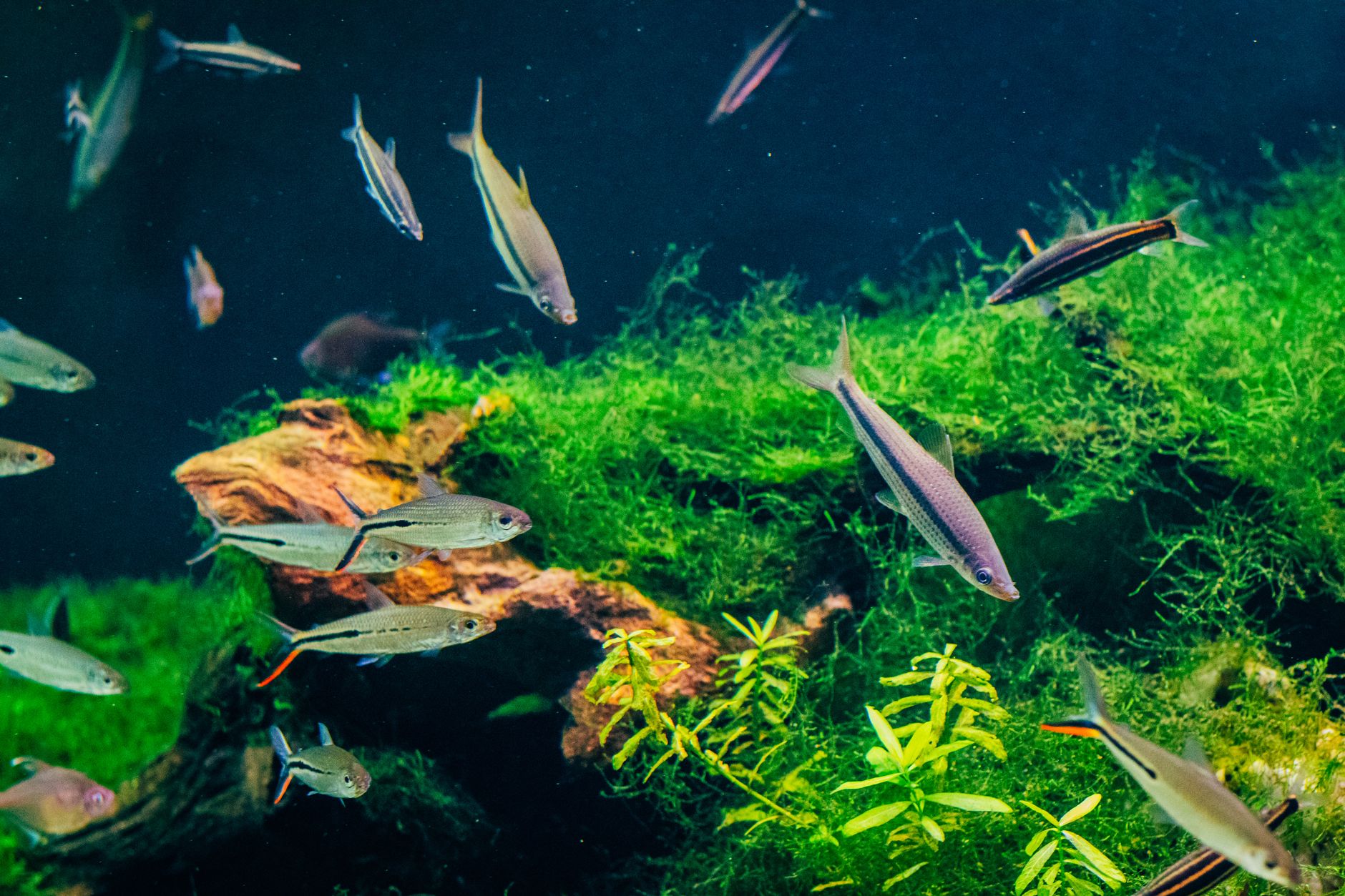
The cardinal tetra is the fish people point at and ask if it is fake. The red stripe runs the full length of the body from eye to tail, with an iridescent blue stripe above it that glows under almost any light. They stay small at 1.75 to 2 inches, so a 20-gallon long holds a proper school of 12. Ten is the minimum and 20 looks better. They school tightly, swim in the middle of the water column, and cause no trouble with anyone.
Water chemistry is the hard part and it is not negotiable. Cardinals come from blackwater rivers with almost no dissolved minerals. They want pH 5.0 to 6.8 and hardness of 1 to 6 dGH. Most tap water runs 7.4 to 8.2 pH with 8 to 14 dGH, which is the exact opposite. Wild-caught cardinals dropped into hard tap water often die within a week, and drip acclimation only softens the blow. Captive-bred stock is more forgiving but not bulletproof. If your tap water is hard, plan on mixing it with RO water or choose a different fish. The cardinal tetra care guide explains the acclimation process in detail.
In the right water they are easy. Add Indian almond leaves or a blackwater extract, keep the temperature at 75 to 80°F, and pair them with angelfish, Bolivian rams, and corydoras. Skip them if your tap water is liquid rock. Life span runs 3 to 5 years in a stable tank, and losses during the first two weeks almost always mean something in the water is wrong rather than something wrong with the fish themselves.
Key strengths:
- ✅ Full-length red stripe and a blue band that stays bright under ordinary lighting.
- ✅ Schools tightly in the mid-water column, which fills an empty part of the tank.
- ✅ Small adult size at 1.75 to 2 inches, so 12 fish fit a 20-gallon long.
- ✅ Peaceful with angelfish, rams, and corydoras in a soft-water setup.
- ✅ Long lived for a small tetra, often 3 to 5 years in stable water.
- ❌ Needs soft, acidic water at pH 5.0 to 6.8 and 1 to 6 dGH, which most tap water cannot provide.
- ❌ Wild-caught stock is delicate and frequently dies during acclimation.
- ❌ Needs a group of at least 10, so a small tank is not an option.
Who it’s for: Choose cardinal tetras if you can supply soft, acidic water and want a large, tight school in a 20-gallon long or bigger.
Frequently Asked Questions
What is the best beautiful freshwater fish for a beginner?
A single male betta in a heated, filtered 5-gallon tank. It needs the least space of the five species here, tolerates a wide pH range, and interacts with its keeper. If you want a fish that shares the tank with others, a Bolivian ram in a 20-gallon long is the next easiest choice.
Can angelfish live with cardinal tetras?
Sometimes, and only in a large tank. Angelfish eat fish that fit in their mouths, and adult cardinals sit right at the edge of that size. The pairing works best when the angelfish are raised alongside the tetras from a young age in a 55-gallon or larger tank.
Do betta fish really need a heater?
Yes. Bettas are tropical fish and do best between 78 and 80 degrees Fahrenheit. A bowl at room temperature sits in the high 60s, which suppresses the immune system and leads to fin rot and other infections. A small adjustable heater is the most useful purchase for a betta tank.
What water temperature should a freshwater community tank run at?
Most of the fish here want 74 to 80 degrees. Angelfish prefer the warmer end at 78 to 82, dwarf gouramis handle 72 to 82, and Bolivian rams and cardinal tetras do well at 74 to 80. Pick a middle number, set the heater, and stop adjusting it.
Why do cardinal tetras die in hard tap water?
They come from rivers with almost no dissolved minerals, and their bodies are built for very soft, acidic water. Hard, alkaline tap water stresses them through the gills and skin, and wild-caught fish often die within two weeks. Mixing with RO water or buying captive-bred stock helps, but the water still has to match.
Which of these five fish is the hardest to keep?
Cardinal tetras and dwarf gouramis. Cardinals need soft, acidic water that most tap supplies cannot provide, and dwarf gouramis carry a fatal iridovirus with no available treatment. Angelfish are demanding in a different way because they need a tall tank and they eat small tank mates.
What Should You Remember?
- Betta fish need 5 gallons, a heater at 78-80°F, and a lid, not a 2-gallon bowl.
- Angelfish need 29 gallons for one and 55 for a group, and they eat neon-sized tetras once they reach adult size.
- Dwarf gouramis fit a 10-gallon tank and breathe at the surface, but iridovirus makes every purchase a gamble.
- Bolivian rams are the hardiest dwarf cichlid in this group at 74-80°F and hardness up to 15 dGH.
- Cardinal tetras need pH 5.0 to 6.8 and 1 to 6 dGH, so hard tap water is a dealbreaker.
- Cycle the filter first and keep a liquid test kit on hand for the first month of any new tank.
- Stable temperature beats medication: an adjustable heater prevents more disease than any bottle of treatment.
This article is for general information only and is not a substitute for professional veterinary or aquarium specialist advice. Always research the specific needs of your fish and consult an expert before making care decisions.