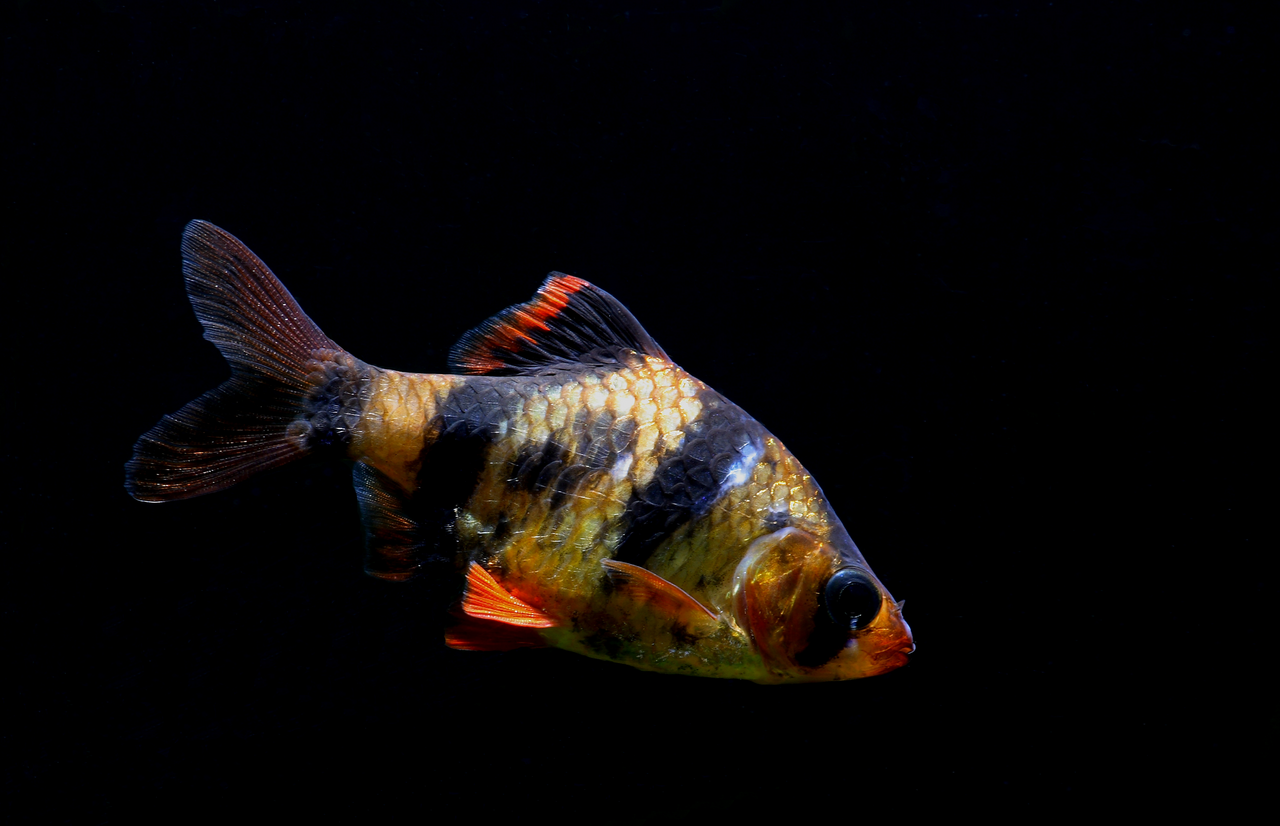
Tiger barbs are one of the most recognizable freshwater fish in the hobby. They have bright orange bodies, black vertical bands, and a constant need to move. Many new keepers buy them because they are cheap, colorful, and active. The catch is that tiger barbs are also famous for nipping fins and harassing slower tank mates. That does not mean they are hard to keep. It means they need the right group size, tank dimensions, and tank mate choices from day one.
Tiger barbs (Puntigrus tetrazona) come from slow-moving streams and tributaries in Borneo, Sumatra, and other parts of Southeast Asia. In the wild they form large schools and forage for small invertebrates, plant matter, and detritus. According to Seriously Fish, this social structure is the key to their behavior in captivity. A single tiger barb is not a happy fish. A proper school spreads out dominance behavior and creates a much calmer display.
This guide is a complete 2026 care reference. You will learn the exact tank size, water temperature, pH range, diet, and compatible tank mates for tiger barbs. We also cover setup, feeding routines, maintenance, and common mistakes. If you are just starting a new tank, review the aquarium nitrogen cycle guide before adding any fish. A cycled filter is the foundation for every tiger barb setup.
By the end of this article, you will know how to keep a healthy, active school of tiger barbs without constant battles. The main rule is simple: keep them in a large enough group, give them a long tank, and do not pair them with slow or long-finned fish. Follow these steps and your tiger barbs will show brilliant color, bold feeding behavior, and far less aggression than their reputation suggests.
What You’ll Need
- 20-gallon long aquarium or larger
- Adjustable heater
- Thermometer
- Hang-on-back or sponge filter
- API Freshwater Master Test Kit
- Water conditioner
- Gravel vacuum
- Live or silk plants and driftwood
How Do You Care for Tiger Barbs?
- Choose a 20-gallon long tank at minimum and stock a proper school.
Tiger barbs are small but extremely active. A single tiger barb reaches about 2.5 to 3 inches long and never stops cruising. The common mistake is treating them like a calm tetra that can live in a 10-gallon. A group of six in a 10-gallon will fight constantly because there is not enough horizontal space to break line of sight. Start with a 20-gallon long tank for six to eight fish. If you can go bigger, a 30-gallon or 40-gallon breeder is even better because it gives the school room to dash without cornering a weaker fish. According to Aqueon, tiger barbs are an active schooling species that needs enough room to reduce aggression.
Schooling is not optional for this species. Tiger barbs live in large groups in the wild, and that social structure dilutes aggression. A lone tiger barb often becomes reclusive or turns into a fin-nipping terror. Two or three fish is worse because they form a weak pecking order and the lowest ranked fish gets bullied nonstop. Keep at least eight if possible. In a 20-gallon long, eight is manageable. In a 40-gallon breeder, ten to twelve is even better and makes for a much more natural display.
Think about future upgrades before buying. Many keepers start with a 20-gallon and later want to add more barbs or tank mates. A 29-gallon has a similar footprint to a 20-gallon long but adds height. That extra height does less for tiger barbs than horizontal length. A 40-gallon breeder is 36 inches long and 18 inches deep, which is ideal for a larger school plus a few fast dither fish. If you are still cycling the new tank, review the steps in our guide on how to cycle a fish tank before adding fish.

- Dial in warm, soft to neutral water and finish the nitrogen cycle.
Tiger barbs are tropical fish. They do best in water kept between 74 and 79 degrees Fahrenheit (23 to 26 degrees Celsius). They will tolerate brief swings, but consistent warmth supports activity, digestion, and color. A reliable adjustable heater is better than a preset heater because you can respond to room temperature changes. Use a thermometer to confirm the actual tank temperature. Relying on the heater dial alone is a common mistake.
Aim for a pH between 6.0 and 7.5. Tiger barbs are adaptable, but they thrive in slightly acidic to neutral water. Hardness is less critical for tank-raised fish, but avoid extreme liquid rock water if you can blend with reverse osmosis or rain water. More important than exact numbers is stability. Rapid pH shifts are more dangerous than a stable pH of 7.6. Test the water before every water change until you know what your source water does.
The tank must be fully cycled before tiger barbs go in. Cycling builds the beneficial bacteria that process ammonia into nitrite and then nitrate. High ammonia or nitrite will quickly strip their slime coat and cause red gills or gasping. Use an API Freshwater Master Test Kit to track ammonia, nitrite, and nitrate for the first six weeks. Ammonia and nitrite should read 0 ppm before any fish is added.
After cycling, keep nitrate below 20 to 30 ppm through weekly water changes. If your tap water has ammonia or high nitrate, add a quality water conditioner and consider a planted setup to help consume nitrate. Stability matters more than chasing a perfect pH. If you need to lower pH, do it slowly and test often. A sudden drop can kill the beneficial bacteria and stress the school.
- Use gentle filtration, a dependable heater, and modest lighting.
Tiger barbs produce a good amount of waste for their size, especially in a group of eight or more. A hang-on-back filter or a small canister filter rated for at least twice the tank volume works well. If you have a 40-gallon breeder, choose a filter rated for 70 to 80 gallons. Sponge filters are also excellent because they provide biological filtration and gentle flow. Tiger barbs come from slow-moving streams, but they can handle moderate current. Too much flow pushes them against the glass and wastes their energy.
The heater should be sized to the room. In a cold room, a 100-watt heater is safer for a 20-gallon long than a 50-watt model. Place the heater near the filter outflow so warm water circulates evenly. I prefer an adjustable heater with a separate digital thermometer. The separate thermometer catches heater failure early. In very warm climates, you may need a fan or open lid on hot days. If you need product recommendations, check our list of best aquarium heaters. For a dependable unit, Check adjustable aquarium heaters on Amazon.
Lighting for tiger barbs is simple. They do not need intense light, but plants do. A low to medium output LED light on a 6 to 8 hour timer works well. Long light hours encourage algae, and bright light may make tiger barbs skittish if there is not enough cover. Floating plants like water sprite or frogbit can dim the light naturally. If you want to grow live plants, start with easy species.
For filtration, avoid anything with a strong intake that can suck up small barbs. Use a pre-filter sponge on the intake tube. That also protects fry if your barbs ever spawn. A hang-on-back filter sized for double your tank volume is a good starting point. Check Fluval hang on back filters on Amazon if you need a reliable option.
- Feed a varied omnivore diet with small, frequent meals.
Tiger barbs are not picky eaters. In the wild they eat small invertebrates, insects, plant matter, and detritus. In the aquarium, a high-quality tropical flake or micro pellet can serve as the base. Choose a formula with whole fish or insect meal as the first ingredient rather than wheat. Feed small pinches two to three times per day. A tiger barb’s stomach is roughly the size of its eye, so each meal should be eaten within 60 to 90 seconds.
Variety prevents nutritional gaps and boosts color. Add frozen or live foods like bloodworms, brine shrimp, daphnia, and mosquito larvae two to four times a week. Blanched zucchini, shelled peas, and spirulina flakes provide plant matter. Do not feed only freeze-dried tubifex or only flakes. A rotation keeps the fish active and supports immune health. For a convenient high-protein option, Check Fluval Bug Bites tropical formula on Amazon works well for barbs.
Overfeeding is the biggest dietary risk. Tiger barbs beg constantly and will eat until they look bloated. Uneaten food rots and spikes ammonia. Feed less if you see long stringy feces or round bellies after meals. Skip feeding one day per week to let their digestive systems clear. If you keep bottom dwellers with your barbs, use sinking pellets after the barbs have had their floating food so slower fish get a share.
A good feeding routine also makes tiger barbs easier to observe. Healthy barbs dash to the surface but do not gasp. If fish hide during feeding or spit food, test the water and look for signs of stress. Newly added barbs may refuse food for a day or two, which is normal. After that, their appetite should return quickly.

- Choose fast, short-finned tank mates or keep a species-only setup.
Tiger barbs have a bad reputation because they nip long fins. The behavior comes from their social harassment and high energy. The safest display is a species-only tank with eight to twelve tiger barbs. The school will chase, flare, and sort out dominance without injuring other species. A species-only setup lets you keep a larger group and see the most natural behavior.
If you want a community tank, choose tank mates that can ignore or outswim the barbs. Good options include zebra danios, harlequin rasboras, larger tetras like black skirt tetras, and fast minnows. Bottom dwellers like corydoras catfish can work because they stay low and do not have flowing fins. Avoid slow, long-finned fish such as bettas, angelfish, gouramis, and male guppies. Tiger barbs will target their trailing fins and stress them until infection sets in.
Think about tank size before adding any other species. A 20-gallon long with eight tiger barbs has little room for a separate school. A 40-gallon breeder can support the barb school plus a group of zebra danios or harlequin rasboras. Fast, short-finned fish add movement without triggering constant aggression. Avoid slow cichlids or territorial bottom fish that might fight back and injure the barbs.
Always quarantine new fish for at least two weeks before adding them to the main tank. Tiger barbs are active and curious, so they will inspect newcomers closely. If a new fish arrives with ich or a bacterial infection, the stress of being chased can make the illness worse. Use a separate quarantine tank with a sponge filter and heater. This is even more important if you keep a large, established barb school.

- Decorate with plants, driftwood, and clear swimming lanes.
Tiger barbs need both cover and open water. In a bare tank, dominant fish chase subordinates continuously because there is nowhere to hide. In a heavily planted tank without open space, the school cannot dash and may become skittish. Aim for a mix. Place live or silk plants along the back and sides, leaving the front two-thirds of the tank open for swimming.
Driftwood and rocks create sight breaks. A long piece of Malaysian driftwood in the center divides the tank into two visual zones. When a barb gets chased, it can swim behind the wood and disappear. This reduces stress and prevents injury. If you use live plants, choose hardy species that can handle nibbling and active water movement. Java fern, anubias, hornwort, and water wisteria are good choices. Our best aquarium plants for beginners guide lists setups that work well with barbs.
Substrate choice is flexible. Fine gravel or sand both work. Sand is easier to clean and looks natural. Tiger barbs do not dig, but they will pick at food on the substrate. Avoid sharp crushed coral because it can raise pH and scratch barbels. If you want a planted tank, use root tabs or a nutrient-rich substrate under sand. The plants will help keep nitrate low between water changes.
Tiger barbs also appreciate some floating plants. Water sprite and frogbit soften the light and make the fish feel secure. Do not let floating plants cover the entire surface because tiger barbs need access to the surface for feeding and oxygen exchange. A partial cover is enough.
- Set a weekly maintenance schedule and watch for signs of stress or disease.
Tiger barbs are hardy, but they are sensitive to old water and sudden parameter shifts. Change 25 to 30 percent of the water every week using a gravel vacuum. In a 20-gallon long, that means removing 5 to 6 gallons and replacing it with dechlorinated water of similar temperature. In a larger tank, 30 percent still works. Weekly changes keep nitrate low and remove dissolved organics that fuel algae.
Test the water before the change and 24 hours after. You should see ammonia 0 ppm, nitrite 0 ppm, and nitrate under 30 ppm. If nitrate climbs above 40 ppm, increase the water change percentage or add fast-growing plants. Our guide on how often to change aquarium water gives a full schedule. If you see cloudy water or a strong odor, do an immediate 30 percent change and check the filter.
Watch for disease signs during feeding time. Tiger barbs are prone to ich when stressed or chilled. Look for white spots on fins, clamped fins, rapid breathing, or rubbing against decor. If you catch ich early, raising the temperature slowly to 82 degrees Fahrenheit and using a quality ich treatment can work. Quarantine any sick fish if possible.
Also watch for aggression injuries. Torn fins, missing scales, or a fish hiding constantly means the social balance is off. Add more tiger barbs, rearrange the hardscape, or move the aggressor temporarily. Sometimes removing a single dominant barb for a week resets the pecking order. After re-adding it, the group may accept it more peacefully. Do not add long-finned fish to solve aggression. That makes it worse.
Red Flags & Warnings
- 🚨 Never keep fewer than six tiger barbs. A small group raises aggression and often ends with the weakest fish being killed.
- 🚨 Do not add long-finned or slow-moving fish like bettas, angelfish, or fancy guppies. Tiger barbs will shred their fins.
- 🚨 Quarantine all new fish for at least two weeks. Tiger barbs stress newcomers, which can trigger ich or bacterial outbreaks.
- 🚨 Avoid sudden temperature swings. A heater failure or cold water change weakens their immune system quickly.
- 🚨 Do not overfeed. Tiger barbs are gluttonous and will bloat or foul the water if given too much food.
- 🚨 Keep the tank covered. Tiger barbs are fast and can jump when startled or during feeding.
Frequently Asked Questions
How many tiger barbs should I keep together?
Keep at least six, but eight to ten is much better. Larger schools spread out aggression and create a more natural behavior. A single pair or trio will likely fight.
What is the minimum tank size for tiger barbs?
A 20-gallon long tank is the minimum for six to eight fish. For a school of ten to twelve with tank mates, use a 30-gallon or 40-gallon breeder.
Can tiger barbs live with angelfish or bettas?
No. Both have long, flowing fins that tiger barbs will nip. Keep tiger barbs with fast, short-finned fish or in a species-only tank.
What water temperature and pH do tiger barbs need?
They do best at 74 to 79 degrees Fahrenheit with a pH between 6.0 and 7.5. Stability matters more than hitting one exact number.
What do tiger barbs eat?
Feed high-quality flakes or micro pellets as a base. Add frozen or live bloodworms, brine shrimp, daphnia, and some blanched vegetables several times a week.
Are tiger barbs good for beginners?
Yes, they are hardy and active, but they require a properly sized school and tank. Beginners should avoid mixing them with slow, long-finned community fish.
What Should You Remember?
- School size: Keep at least 8 tiger barbs to spread out aggression and stress.
- Minimum tank: Use a 20-gallon long tank for a small school; 40 gallons is better for a large group.
- Water parameters: Maintain 74-79°F and pH 6.0-7.5 with zero ammonia and nitrite.
- Diet: Feed small portions of varied omnivore foods 2-3 times per day.
- Tank mates: Stick to fast, short-finned fish or keep a species-only setup.
- Tank setup: Use plants, driftwood, and open swimming space to reduce chasing.
- Maintenance: Change 25-30 percent of the water weekly and quarantine new arrivals.
This article is for general information only and is not a substitute for professional veterinary or aquarium specialist advice. Always research the specific needs of your fish and consult an expert before making care decisions.