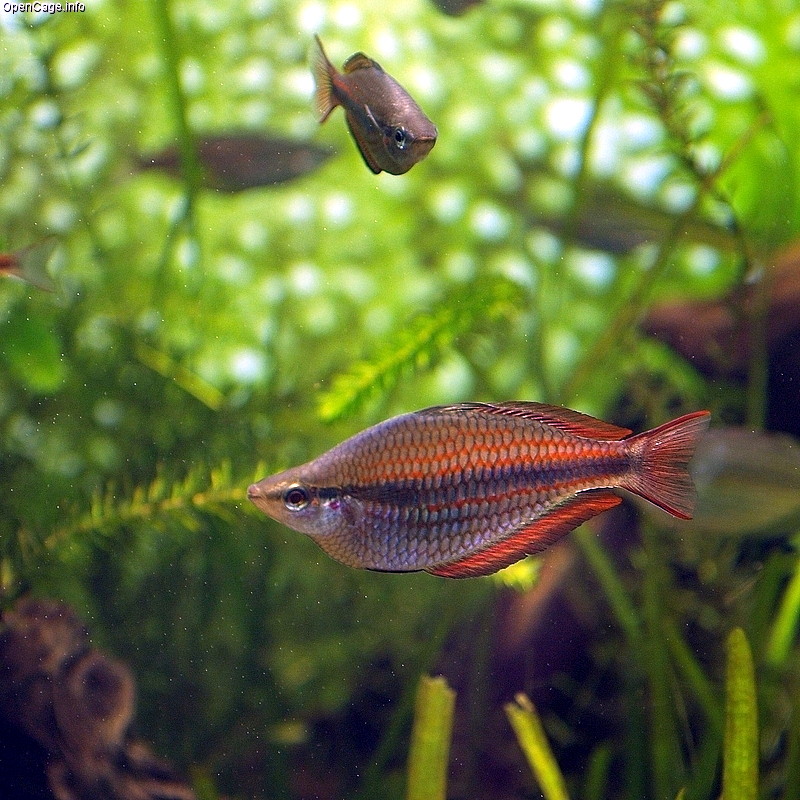
Rainbowfish are among the most colorful freshwater fish available in the hobby. Their iridescent blues, yellows, and reds make them a centerpiece in planted community tanks. They are active, peaceful, and usually long-lived once established. Still, rainbowfish are not a throw-in fish. They need a proper school, a long tank, and stable water. If you are weighing options for a new setup, our best fish for beginners guide can help you compare rainbowfish with other beginner-friendly species before you commit.
Most rainbowfish sold in stores are juveniles. They often look pale and thin. That leads many keepers to underestimate their adult size and energy level. A crowded tank makes them dull and stressed. Given space, they develop deep color and bold personalities. You also need to plan for a group. Rainbowfish are schooling fish. A solo rainbowfish hides, eats poorly, and may never show its true color. This guide covers tank size, diet, compatibility, and the daily habits that keep them healthy in 2026.
The good news is that rainbowfish care is straightforward once you understand their origin. Many species come from hard, alkaline waters in Australia and New Guinea. That means they often thrive in tap water that would stress soft-water species like discus or neon tetras. They are also less picky about food than many tropical fish. The main challenges are space, water stability, and choosing tank mates that match their speed. Follow the steps below to build a tank where rainbowfish can live for years.
What You’ll Need
- 55-gallon or larger aquarium with secure lid
- Hang-on-back or canister filter rated for the tank volume
- Aquarium heater with thermostat
- LED lighting with adjustable brightness
- API Freshwater Master Test Kit
- Fine gravel or sand substrate
- Live plants and driftwood
- Varied fish food including high-quality flakes, micro pellets, and frozen foods
How Do You Care for Rainbow Fish?
- Choose the right rainbowfish species and tank size.
Rainbowfish are schooling fish. Most species need company. The popular Boesemani rainbowfish reaches about 4 inches. Dwarf neon rainbowfish stays around 2.5 inches. Start with a 55-gallon tank for a school of six adult Boesemani. Smaller species can live in a 30-gallon long tank, but bigger is easier. Use our best beginner fish tanks guide to compare tank footprints.
A long tank works better than a tall one. Rainbowfish swim in open water. Length gives them room. A 48-inch tank is ideal. Aqueon’s rainbowfish care overview also stresses the need for a long, spacious aquarium. Plan for the adult size, not the juvenile size. Many rainbowfish are sold at 1 to 2 inches. They grow quickly.
A cramped tank causes stress and dull color. It also raises aggression within the school. If you can, choose a 75-gallon tank for a mixed rainbowfish community. That gives you room for a larger group and some tank mates. The catch is that a bigger tank still needs a strong filter and regular maintenance. But the extra water volume makes water parameters more stable.
Substrate choice matters less. Use fine gravel or sand. Rainbowfish do not dig much. Dark substrates can make their colors pop. Add a secure lid. Rainbows are strong jumpers. They may jump during feeding or when startled.
- Decorate with plants and open swimming space.
Rainbowfish look best in a planted tank. Plants provide cover and reduce stress. But these fish need open water. Do not overplant the middle. Leave a channel for swimming. Use tall plants along the back and sides. This gives the school a clear runway.
Good plant choices include java fern, anubias, vallisneria, and amazon swords. These tolerate hard, alkaline water. Rainbowfish often prefer harder water than many soft-water plants. Attach java fern and anubias to driftwood. Add floating plants to diffuse light. They also help nervous fish feel safe.
Use a dark background. It brings out the blue, yellow, and red colors. Position a powerhead or strong filter output at one end. Rainbowfish enjoy moderate water flow. It mimics their natural river and lake habitats. But leave calm areas behind plants or hardscape.
Driftwood and rocks are fine. Just avoid sharp edges. Rainbowfish are fast and can scrape themselves if startled. Smooth the wood. Arrange hardscape before adding water. A well-planned layout saves you from moving decorations later.

- Install a strong filter, heater, and lighting.
Rainbowfish need clean, oxygen-rich water. Use a filter rated for at least the tank volume, preferably more. A hang-on-back filter like the AquaClear 70 works on many 55-gallon tanks. Check the AquaClear 70 power filter on Amazon. Canister filters are also good for longer tanks. Compare options in our best aquarium filters 2026 guide.
Set the water temperature to 75 to 82 degrees Fahrenheit. Rainbowfish are tropical. Use a heater with a thermostat. In larger tanks, two smaller heaters provide backup. But do not rely on a single oversized heater. A failure can overheat the tank fast.
Lighting should be moderate. Bright light can stress rainbowfish. Use an adjustable LED fixture. Keep it on for 8 to 10 hours per day. Too much light encourages algae. It also washes out fish color. Plants like anubias and java fern do fine under low to medium light.
Add a thermometer. Check the heater setting daily. Rainbowfish are sensitive to rapid temperature swings. A stable temperature is more important than an exact number within the range. Adjust room conditions if the water runs too warm in summer.
- Cycle the tank before adding rainbowfish.
Never add rainbowfish to an uncycled tank. The nitrogen cycle must be established first. Our how to cycle a fish tank guide gives step-by-step instructions. Rainbowfish are not hardy enough for fish-in cycling. Ammonia and nitrite burns damage their gills. It can cause death within days.
Use a liquid test kit to monitor the cycle. Check the API Freshwater Master Test Kit on Amazon. You want 0 ppm ammonia, 0 ppm nitrite, and under 20 ppm nitrate before adding fish. A liquid kit measures these accurately. Test strips can be less precise. Do not skip this step.
The cycle usually takes 4 to 6 weeks. You can speed it with bacteria starters. Add ammonia or fish food to feed the bacteria. Keep the filter running. Do not change water during cycling unless ammonia or nitrite gets extremely high. A mature filter is key for rainbowfish.
After the cycle, add fish gradually. Rainbowfish are social, but adding a large school at once can overload the biofilter. Start with six juveniles if the tank was cycled with enough ammonia. Closely test water for the first two weeks. If ammonia or nitrite appears, do a 25 percent water change.

- Match water parameters and maintain them.
Rainbowfish do best in stable water. Aim for pH 7.0 to 8.0. Hardness should be 8 to 20 dGH. Temperature stays in the 75 to 82 degree Fahrenheit range. These fish come from alkaline lakes in Australia and New Guinea. Very soft, acidic water can dull their color and weaken their immune systems.
Do not chase a perfect pH. Rapid swings do more harm than a slightly off pH. If your tap water is naturally hard and alkaline, rainbowfish usually adapt well. Our how often to change aquarium water guide explains how to keep things stable with regular water changes. Change 25 to 30 percent weekly. Remove waste and replenish minerals.
Test your tap water before use. If it is very soft, add crushed coral to the filter or substrate. This slowly raises hardness and pH. Use a mesh bag of crushed coral. Check the tank every few days until parameters settle. Avoid chemical pH adjusters if possible. They often cause swings.
Observe the fish after each water change. Rainbows should swim actively and breathe normally. If they gasp at the surface or clamp their fins, check dissolved oxygen and temperature. Add an air stone if needed. Water movement from the filter helps too.
- Feed a varied omnivore diet.
Rainbowfish are omnivores. They eat insects, crustaceans, algae, and plant matter in the wild. Feed a quality staple like high-quality flakes or micro pellets. Check Hikari Micro Pellets on Amazon is a good choice for small to medium species. Offer small portions twice a day. Food should be eaten within two minutes.
Variety matters. Include frozen or live foods. Bloodworms, brine shrimp, daphnia, and blackworms are all excellent. Feed these several times per week. Frozen foods boost color and condition. Rinse frozen cubes before use to remove excess phosphate. This helps prevent algae.
Add some vegetable matter. Spirulina flakes, blanched zucchini, or shelled peas can be offered once or twice a week. This aids digestion. It can also reduce the chance of bloat. Do not overfeed. Rainbowfish are active and fast eaters. They may trick you into thinking they are still hungry.
Skip large pellets for small rainbowfish. Their mouths are not huge. Crush foods if needed. Feed juvenile rainbowfish more often, maybe three small meals daily. Adults do fine on two. Remove uneaten food after a few minutes. This keeps water quality high.

- Choose compatible tank mates.
Rainbowfish are generally peaceful. But they are fast. Slow, shy tank mates may struggle. Choose active community fish. Good options include harlequin rasboras, congo tetras, larger tetras, and peaceful barbs. Our harlequin rasbora care guide covers a good schooling companion.
Avoid fish with long, flowing fins. Rainbowfish may nip at them, especially if underfed or in small groups. Bettas and angelfish are not ideal. They can become targets. Small shrimp may also be eaten. Adult rainbowfish reach 3 to 4 inches and will eat small invertebrates.
Good tank mates also include peaceful bottom dwellers. Corydoras catfish and bristlenose plecos work well. They stay out of the rainbowfish’s main swimming area. Just make sure your tank is large enough. Overcrowding creates stress. Aim for one inch of adult fish per gallon as a rough starting point, but rainbows need more swimming space.
Add schooling fish in proper groups. Harlequin rasboras do best in groups of eight or more. Bigger tetras also school. A 75-gallon tank lets you keep a nice community. Watch interactions during feeding. Rainbows are fast and may hog food. Feed sinking foods for bottom dwellers.
- Quarantine, acclimate, and monitor health.
Quarantine new rainbowfish before adding them to the display. Use a separate 10 to 20 gallon tank. This protects your established school. New fish can carry ich, velvet, or internal parasites. A two to four week quarantine gives you time to observe.
Acclimate rainbowfish slowly. Float the bag for 15 minutes. Then drip acclimate using airline tubing. Match temperature and water chemistry over 30 to 45 minutes. Do not pour pet-store water into your tank. Net the fish and release them gently.
After adding rainbowfish, watch for signs of disease. White spots, clamped fins, or rapid breathing need attention. Most common parasites can be treated in a hospital tank. Many medications can affect plants and invertebrates. Treating separately also keeps your display tank stable.
Keep a log. Record water test results, feeding, and behavior. This helps you spot small changes before they become big problems. Rainbowfish can live five to eight years with good care. A consistent routine is the best prevention.
Red Flags & Warnings
- 🚨 Do not keep a single rainbowfish or a very small group. They become stressed, hide, and show washed-out colors. Six is the minimum.
- 🚨 Always use a tight-fitting lid. Rainbowfish are powerful jumpers and can launch out of the tank when startled.
- 🚨 Avoid slow, long-finned tank mates. Rainbowfish may nip fins, especially if the school is too small or feeding is inconsistent.
- 🚨 Never add rainbowfish to an uncycled tank. Ammonia and nitrite spikes can kill them quickly.
- 🚨 Do not make rapid pH or hardness changes. Treat water gradually and test regularly to avoid shock.
- 🚨 Quarantine new arrivals for two to four weeks. Rainbowfish can carry parasites that spread fast in a display tank.
Frequently Asked Questions
What size tank do rainbowfish need?
A 55-gallon tank is the best starting point for a school of six adult Boesemani rainbowfish. Smaller species like dwarf neon rainbowfish can live in a 30-gallon long tank. A bigger tank is always better because rainbowfish are active swimmers.
Are rainbowfish aggressive?
Rainbowfish are generally peaceful schooling fish. They may nip at long-finned or slow-moving tank mates if stressed or kept in small groups. Keeping six or more and providing space reduces aggression.
What do rainbowfish eat?
Rainbowfish are omnivores. Feed high-quality flakes or micro pellets daily, plus frozen foods like bloodworms and brine shrimp several times a week. Add some vegetable matter such as spirulina flakes or blanched zucchini.
Can rainbowfish live with angelfish?
It is not ideal. Angelfish are slower and have long fins, which rainbowfish may nip. Rainbowfish also prefer slightly harder water than angelfish typically do. Choose faster tank mates instead.
How many rainbowfish should be kept together?
Keep at least six of the same species for natural schooling behavior. Larger groups are even better. A group of eight to ten shows better color and less stress.
Do rainbowfish need live plants?
Live plants are not strictly required, but they help. Plants provide cover, improve water quality, and reduce stress. Leave open swimming areas in the middle of the tank.
What Should You Remember?
- School size: Keep at least six rainbowfish together to reduce stress and bring out full color.
- Tank size: Set up a 55-gallon or larger long tank for adult rainbowfish schools.
- Water parameters: Maintain 75 to 82 degrees Fahrenheit, pH 7.0 to 8.0, and 8 to 20 dGH for most rainbowfish.
- Diet: Feed a varied omnivore diet with quality flakes, micro pellets, frozen foods, and some plant matter.
- Tank mates: Choose fast, peaceful schooling fish and avoid slow, long-finned species.
- Quarantine: Isolate new rainbowfish for two to four weeks before adding them to the display tank.
This article is for general information only and is not a substitute for professional veterinary or aquarium specialist advice. Always research the specific needs of your fish and consult an expert before making care decisions.